QuestX blog is in the process of moving over to QuestX.net / QuestX.net/blog !
We're in the process of updating the website and consolidating the blog on to our web page.
It will take us some time to get this all up to date, I'm hoping by Jan., 2020!
Please excuse our mess while we get this all sorted through and cleaned up.
A lot has been going on and we'll have loads to share with you later this year...
...stay in touch with us for upcoming adventures, events, podcasts, videos, activities, research, outings, news, curiosities, and other science "stuff"!
oh! ...and for some reason Firefox does not like the current web page set up and does not consistently work for our site, we'll be sorting that out too! (the other browsers seem to work fine...)
…for more QuestX :
QuestX is also on Google+
/ YouTube (QuestX), Facebook(@QuestX.net), & Twitter (@QuestX1)
Yep... scientists researching the ecology of scavengers (in other words> studying how animals that feed on dead animal or plant matter interact with each other and their environments) during winter in the Great Basin Desert, Utah, staked out 7 calf carcasses (each with an associated trap camera) and got an unexpected result...
Badgers!
Scientific researchers in Great Basin Desert, Utah, caught American badgers (on trap cameras) caching cows.
While badgers are known scavengers, the researchers hadn't planned on
studying any mustelids, including badgers.
Badgers are hard to study since they are generally active underground or are nocturnal (out and about at night), so their behaviors aren't well-known. Last winter (January, 2016) the researchers caught two badgers (images,
not the badgers themselves! ; ) caching two of the staked out carcasses. This is the first evidence of a badger caching / burying an animal larger than itself.
Here is a video (from a trap camera) of one of those badgers caching /burying it's find for later:
The Great Backyard Bird Count is a science event that everyone can participate in... even from a chair looking out your window! (the video below was taken from my deck, beware the door squeak!)
Great Blue Heron in Cedar Tree
When? From Friday, Feb. 17, to Monday, Feb. 20, 2017, for as little as 15 minutes at a time OR as long as you want over the 4 day event.
Where? Wherever you are! From looking out your window to trekking through the woods, across a prairie, sitting in your car at park/ riverside... or wherever you are...
Why? To help understand bird populations (and, really, our world) better!
How? Go to GBBC 2017 and sign up to report your bird sightings! It's *even* easier than it sounds (check back here too, Quest will be posting some bird silhouette identification pages that will help to make identification easier for some birders and more info on birding/ participation). We suggest that you register a.s.a.p. and review the entry form, that way you have a better idea of what to watch for! (it's good to note day, time, weather, etc.)
"The Great Backyard Bird Count (GBBC) is a free, fun, and easy event that engages bird watchers of all ages in counting birds to create a real-time snapshot of bird populations. Participants are asked to count birds for as little as 15 minutes (or as long as they wish) on one or more days of the four-day event and report their sightings online at birdcount.org. Anyone can take part in the Great Backyard Bird Count, from beginning bird watchers to experts, and you can participate from your backyard, or anywhere in the world.
Each checklist submitted during the GBBC helps researchers at the Cornell Lab of Ornithology and the National Audubon Society learn more about how birds are doing, and how to protect them and the environment we share. Last year, more than 160,000 participants submitted their bird observations online, creating the largest instantaneous snapshot of global bird populations ever recorded.
The 20th annual GBBC will be held Friday, February 17, through Monday, February 20, 2017. Please visit the official website at birdcount.org for more information and be sure to check out the latest educational and promotional resources."
The posts this week are brief overviews of EACH of the
otter species, focusing on recent information about each species and a
vid or 2...
This is the ONLY freshwater otter in ALL of North America,
and, as long as it can access fresh water for cleaning up,
it is adapted to use brackish and marine habitats to!!!
North American River
Otters are highly adaptable to different types of habitats, but they are very
sensitive to pollution and changes in water quality. They are extremely
playful, and turn almost all regular activities into a game. They do
not tend to pair-bond (though sometimes they do), but males will help to
raise the pups if given the opportunity. Males tend to be more solitary
than females, but they don't do well alone for long periods of time and
will seek out the company of other otters.
This is the ONLY otter species in the world with a population status of "Stable".
Status: Least Concern and Stable
The North American River Otter has a very large range and can be found throughout most of the US (the map below isn't quite accurate, we'll be creating a more accurate map, it is not found in very arid regions). It's habitat overlaps with the sea otter along the west coast of the US.
There are TONS (if you could weigh content on the internet ;) ) of videos "out there" of North American River Otters! GO! ENJOY!!! (but in the mean time, here are a few from us!)
Let's just start with this...
If you want more in-depth reading a few research articles you could explore on these otters includes:
As promised, the posts this week are brief overviews of EACH of the
otter species, focusing on recent information about each species and a
vid or 2...
Neotropical Otters latin name (Lontra longicaudis) means Otter with looong tail!
I hope that you enjoy exploring them!
Unlike most otter
species, Neotropical Otters are relatively solitary and are very elusive even in pristine habitats. Male and female
Neotropical Otters meet one day a year for breeding, and then go their
separate ways. Neotropical Otters prefer clear, fast-flowing water.
Habitat destruction and water pollution are major threats to this
species.
Status: Near Threatened and Decreasing
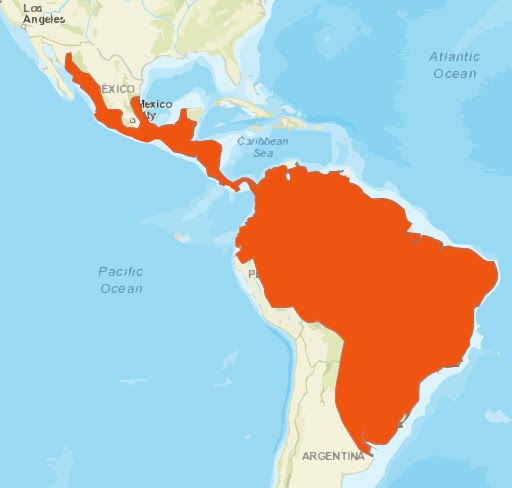
Neotropical Otters are found through most of Mexico all the way south to Argentina (except in arid regions). It's habitat range approaches the North American River Otter to the north and the South American River Otter to the south.
This species occurs in it's range from sea level to 4,000 meters (over 13,000 feet altitude).
This species is very shy and elusive,s o getting good videos isn't easy!
A couple of Neotropical Otters together (wild)
Neotropical Otter videos, swimming and grooming (in captivity)
The posts this week are brief overviews of EACH of the
otter species, focusing on recent information about each species and a
vid or 2...
This
otter shares large parts of it's the marine otter's marine habitat.
Southern River Otters tend
to have a very short life span. Few live to maturity, and only 1% live
to 10 years of age. They are generally solitary, coming together mainly
to mate. The female raises the pups alone, and there are no social
groups beyond this. They have territories like other otters, but the
size of these territories is unknown and it appears that they are not
particularly defensive of them.
Status: Endangered and Decreasing
South American River otters live in fresh and salt water habitats along the lower (primarily western) coast of South America, in red in the map on the left.
The habitat range of the Marine Otter overlaps in Chile with the other
"most southerly" Lontra-otter, the South American River otter.
Southern River otter in captivity, eating.
If you want more in-depth reading a few research articles you could explore on these otters includes:
The posts this week are brief overviews of EACH of the
otter species, focusing on recent information about each species and a
vid or 2...
This otter is second only to the sea otter in it's use of marine environments, only occasionally traveling up freshwater rivers in search of food.
Marine
Otters seem to be the only otter other than the sea otter that do not
require access to fresh water to wash themselves. Though Marine Otters
tend to be solitary, they are generally friendly (but not highly
sociable) with other otters. They do sometimes hunt cooperatively,
groups of two or three otters working together to catch larger fish.
Also, Marine Otters have hairy noses! (Also known as the Sea Cat)
Status: Endangered and Decreasing
Marine Otters (distribution shown in yellow on the map to the left) live along the west coast of South America, from Peru to Chile, with a few noted "around the corner" in Argentina.
They tend to live in diversity rich areas along rocky shores with caves.
The habitat range of the Marine Otter overlaps in Chile with the other "most southerly" Lontra-otter, the South American River otter.
Videos of these agile little otters in the water are amazing to watch!
and on a rocky shore...
If you want more in-depth reading a few research articles you could explore on these otters includes:
> Non-invasive genetic analysis reveals high levels of mtDNA variability in the endangered South-American marine otter (Lontra felina), Juan Valqui (Email), Günther B. Hartl, Frank E. Zachos, 2010
The posts this week are brief overviews of EACH of the
otter species,
focusing on recent information about each species and a
vid or 2...
The Giant Otter is the largest (lengthwise) and oldest (evolutionarily) otter living today.
From nose to tail,
Giant Otters can be up to 6ft long! Their tails are flattened and
flanged, and very strong. Their ears are comparably small, and their
eyes very large. Giant Otters are at the top of their food
chain. They eat fish, small caiman (basically alligators), crustaceans, snakes, and birds.
Giant Otters are incredibly sociable, and often hunt in groups. They
live in family groups of ten or more, sometimes up to twenty otters!
Status: Endangered and Decreasing
The Giant otter range (the area in which the Giant Otter lives) is the central area of South America, especially around the Amazon River Basin and the Pantanal Region.
There are loads of great YouTube videos of Giant Otters out there, but here are a few that we really enjoyed...
Giant Otter hunting...
Giant Otters and a Caiman...
Giant Otter pups at the Los Angeles Zoo
If you want more in-depth reading a few research articles you could explore on these otters includes:
As promised, the posts this week are brief overviews of EACH of the
otter species, focusing on recent information about each species and a
vid or 2...
This species lives in the ocean, along the coast of the North pacific, enjoy! :)
Sea
Otters spend their entire lives in the ocean, only leaving the water in
the case of extremely bad storms. They are also one of the known
tool-using mammals, using rocks to break shells open so they can consume
the shellfish inside. It is important that they are able to do this
well because they have to eat about 30% of their body weight every day!
Status: Endangered and Decreasing
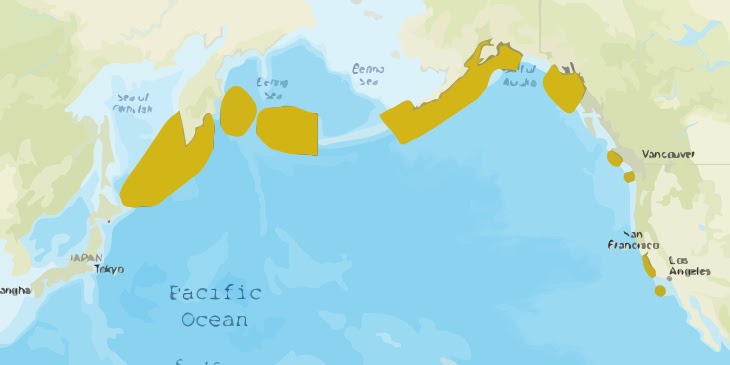
The Sea Otter range traditionally rimmed the outlying land/islands of the northern Pacific Ocean from Baja Mexico around Japan; currently they are restricted to the sporadic range shown in tan below.
Sea Otters at Seattle Aquarium, eating, playing, cleaning, and watching the tourists!
Live WILD Sea Otter mom giving birth near Monterey Bay Aquarium
PBS's NATURE on Sea Otters
Another PBS documentary, thsi time from Jean-Michel Cousteau!
If you want more in-depth reading a few research articles you could explore on these otters includes:
As promised, the posts this week are brief overviews of EACH of the
otter species, focusing on recent information about each species and a
vid or 2...
There is a LOT of information "out there" about the Eurasian Otter,
they are the considered the "typical" otter
(just take a look at that genus and species name! ; ) ;
consider this just a brief intro, a sneak peek, at the only otter species
that can be found on THREE continents!
Eurasian
Otters are found across most of Europe and Asia AND in parts of northern Africa. They are always found near
water, fresh or salt, as long as there are freshwater pools nearby for
drinking and bathing. They tend to live alone except when mating, when
the male and female may stay close together for ~ a week, or for
females when raising a litter. Though they are excellent swimmers,
Eurasian Otters can only hold their breath for about 30 seconds!
Status: Near Threatened and Decreasing
The teal area in the map below shows where the Eurasian Otter is known to exist; it may be found in other small sub-populations not shown.
For our Eurasian Otter videos, we have a treat, one of Questˣ's friends, Andy Coventry, takes some of the most wonderful videos (and photos) of Eurasian otters!
Here is a link to a video he shared with us recently of 2 Eurasian otters swimming in the River Don, Scotland.
Video about the Eurasian Otter Conservation Program, on otter conservation in Israel
...and here's some video from Pembrokeshire,Wales, taken by Dawn and Jim...
...and a white-tailed eagle after an otter's meal off the Island of Mull, watch closely!
As promised, the posts this week are brief overviews of EACH of the
otter species, focusing on recent information about each species and a
vid or 2...
This is the 3rd of the 3 otter species that are found *only* in Asia, !
The Asian
Small-Clawed Otter is the smallest of all otter species, and also, arguably, the
most social. They mate for life, and live in family groups of between
four and twelve, and sometimes up to twenty, otters. The group hunts,
plays, and sleeps together. These otters will travel a long distance out
of water in search of new habitats. They don't generally dive deeper
than their body length in search of food, and spend more time out of the
water than most otter species.
(Was also known as Oriental Small-Clawed Otter).
Status: Vulnerable and Decreasing
The areas in yellow on the map below show where the Asian Small-Clawed Otter lives in southeast Asia. Despite how adaptable they are, they have become extinct in large parts of their original range.
Asian Small-Clawed Otters are very social and gregarious, watch and see for yourself!
Asian Small-Clawed Otters (India) caught on camera by Wild Otters...
Here are a few clips of a family group kept at woodland Park Zoo (who participates in the Species Survival Plan):
...a group of otters is, appropriately, called a romp...
...otters interacting with a crow (starts @ 3.20)...
...nap time at Woodland Park Zoo
If you want more in-depth reading a few research articles you could explore on these otters includes:
As promised, the posts this week are brief overviews of EACH of the
otter species, focusing on recent information about each species and a
vid or 2...
This is one of the 3 otter species that are found *only* in Asia, !
The Smooth Coated
Otter prefers to live in undisturbed areas. They tend to be nocturnal, sometimes hunting alone and sometimes in large groups. Smooth Coated
Otters mate for life, and live in family groups consisting of the mated
pair and their pups (often including full-grown pups). Research demonstrates that the alpha female
is dominant and determines hierarchy within the group, while the alpha
male moves the group through their territory. Smooth Coated Otters are
proficient both on land and in water. They are powerful swimmers, and on
land they climb and jump quite well.
Status: Vulnerable and Decreasing
The Smooth-Coated Otter (in rust on the map below) is found through southern and southeastern Asia, with an apparently isolated population southern Iraq (it's current status throughout the rest of the Middle East is currently unknown).
Even though they tend to be nocturnal, there are some really good videos of smooth-coated otters:
A smooth-Coated Otter in the wild in India...
A family of smooth-coated otters outside of their den (thank you "Wild Otters")
...and night shots from "Wild Otters"
If you want more in-depth reading a few research articles you could explore on these otters includes:
As promised, the posts this week are brief overviews of EACH of the
otter species, focusing on recent information about each species and a
vid or 2...
This is the first of the 3 otter species that are found *only* in Asia, enjoy exploring them!
Very little is known
about the Hairy-Nosed Otter. It is endangered and rare. The
nose is completely covered in hair, and the feet are webbed, with strong
claws.The major threat to Hairy-nosed Otters is from humans: hunting,
habitat competition, destruction, and pollution. Despite efforts to
establish a captive breeding program, there have only been three of
these otters held in captivity (all male).
Status: Endangered and Decreasing
The Hairy-nosed otter is found in small areas scattered across the area shown in purple in the map to the left.
This otter is extremely reclusive and rare, so are the videos:
Brief vid of a young hairy-nosed otter entering the water!
If you want more in-depth reading a few research articles you could explore on these otters includes:
> Food Habitats of the Hairy-nosed otter (Lutra sumatrana) and the Small clawed otter (Amblonyx cinerea)
in Pru Toa Daeng Peat Swamp Rorest, Southern Thailand. Kanchanasakha, B.K. 2007.
> Keep wetlands wet: the myth of sustainable development of tropical peatlands–implications for policies and management ,S Evers, CM Yule, R Padfield, P O'reilly… - Global change …, 2016 > Camera trapping for the study and conservation of tropical carnivores.R Sollmann, A Mohamed, MJ Kelly - The Raffles Bulletin of Zoology, 2013 -