Showing posts with label references. Show all posts

Friday, January 27, 2017

North American River Otter - The BASICS!

North American River Otter
(Lontra canadensis)


The posts this week are brief overviews of EACH of the otter species, focusing on recent information about each species and a vid or 2... 
 
This is the ONLY freshwater otter in ALL of North America, 
and, as long as it can access fresh water for cleaning up,
it is adapted to use brackish and marine habitats to!!!


North American River Otters are highly adaptable to different types of habitats, but they are very sensitive to pollution and changes in water quality. They are extremely playful, and turn almost all regular activities into a game. They do not tend to pair-bond (though sometimes they do), but males will help to raise the pups if given the opportunity. Males tend to be more solitary than females, but they don't do well alone for long periods of time and will seek out the company of other otters.


This is the ONLY otter species in the world with a population status of "Stable".


Status: Least Concern and Stable


The North American River Otter has a very large range and can be found throughout most of the US (the map below isn't quite accurate, we'll be creating a more accurate map, it is not found in very arid regions). It's habitat overlaps with the sea otter along the west coast of the US.


There are TONS (if you could weigh content on the internet ;) ) of videos "out there" of North American River Otters! GO! ENJOY!!! (but in the mean time, here are a few from us!)

Let's just start with this...


If you want more in-depth reading a few research articles you could explore on these otters includes:

>   Genetic variation among populations of river otters in North America: considerations for reintroduction projects, TL Serfass, RP Brooks, JM Novak. Journal of Mamm., 1998 
>   Deciphering ecological barriers to North American river otter (Lontra canadensis) gene flow in the Louisiana landscape, EK Latch, DG Scognamillo, JA Fike. Journal of Am Gen, 2008 
Ten new polymorphic microsatellite loci for North American river otters (Lontra canadensis) and their utility in related mustelids, AS Beheler, JA Fike, G Dharmarajan. Molecular Ecology, 2005 
Characterization of basal seminal traits and reproductive endocrine profiles in North American river otters and Asian small‐clawed otters, HL Bateman, JB Bond, M Campbell, M Barrie. Zoo …, 2009
Perfluorooctanesulfonate and related fluorinated hydrocarbons in mink and river otters from the United States, K Kannan, J Newsted, RS Halbrook. Environmental science & ACS Publ, 2002 
Prey selection by marine-coastal river otters (Lontra canadensis) in Newfoundland, Canada, D Cote, HMJ Stewart, RS Gregory. Journal of Mamm, 2008

Thursday, January 26, 2017

Neotropical Otter - Basics

Neotropical Otter
(Lontra longicaudis)


As promised, the posts this week are brief overviews of EACH of the otter species, focusing on recent information about each species and a vid or 2...
Neotropical Otters latin name (Lontra longicaudis) means Otter with looong tail! 
I hope that you enjoy exploring them!


Unlike most otter species, Neotropical Otters are relatively solitary and are very elusive even in pristine habitats. Male and female Neotropical Otters meet one day a year for breeding, and then go their separate ways. Neotropical Otters prefer clear, fast-flowing water. Habitat destruction and water pollution are major threats to this species.


Status: Near Threatened and Decreasing


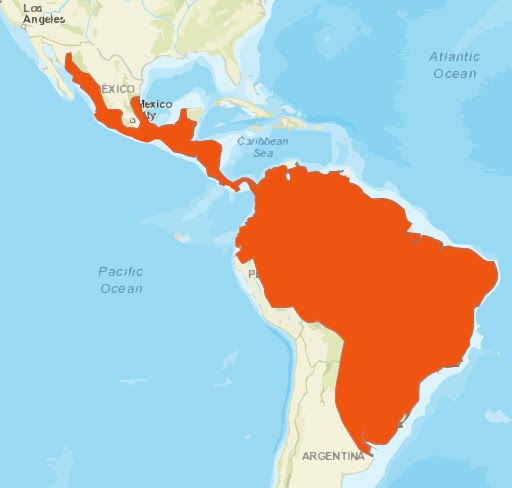
Neotropical Otters are found through most of Mexico all the way south to Argentina (except in arid regions). It's habitat range approaches the North American River Otter to the north and the South American River Otter to the south.


This species occurs in it's range from sea level to 4,000 meters (over 13,000 feet altitude).


This species is very shy and elusive,s o getting good videos isn't easy!

A couple of Neotropical Otters together (wild)


Neotropical Otter videos, swimming and grooming (in captivity)


If you want more in-depth reading a few research articles you could explore on these otters includes:

>   Trophic ecology and the use of shelters and latrines by the Neotropical otter (Lontra longicaudis) in the Taquari Valley, Southern Brazil, CB Kasper, VAG Bastazini, J Salvi. Iheringia. Série, 2008
O Carvalho-Junior, AB Birolo. IUCN Otter Spec., 2010
>   Seasonal and spatial differences in feeding habits of the Neotropical otter Lontra longicaudis (Carnivora: Mustelidae) in a coastal catchment of southeastern. ML Rheingantz, HF Waldemarin, L Rodrigues.  Zoologia , 2011
>   Defining Neotropical otter Lontra longicaudis distribution, conservation priorities and ecological frontiers, ML Rheingantz, JFS de Menezes. Tropical Conservation, 2014

Sea Otter - The Basics

Sea Otter
(Enhydra lutris)


As promised, the posts this week are brief overviews of EACH of the otter species, focusing on recent information about each species and a vid or 2...
This species lives in the ocean, along the coast of the North pacific, enjoy! :)


Sea Otters spend their entire lives in the ocean, only leaving the water in the case of extremely bad storms. They are also one of the known tool-using mammals, using rocks to break shells open so they can consume the shellfish inside. It is important that they are able to do this well because they have to eat about 30% of their body weight every day!


Status: Endangered and Decreasing


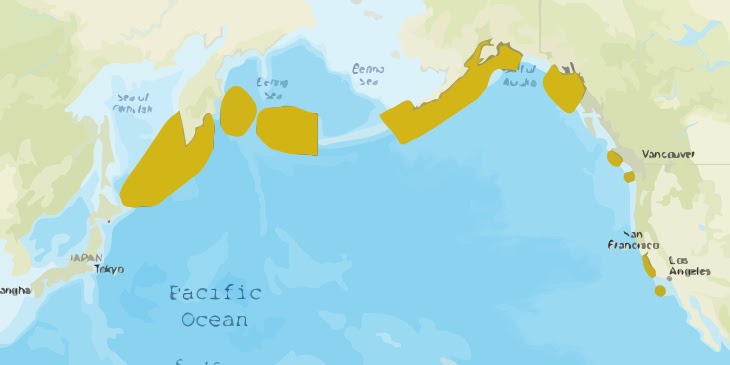
The Sea Otter range traditionally rimmed the outlying land/islands of the northern Pacific Ocean from Baja Mexico around Japan; currently they are restricted to the sporadic range shown in tan below.


Sea Otters at Seattle Aquarium, eating, playing, cleaning, and watching the tourists!


Live WILD Sea Otter mom giving birth near Monterey Bay Aquarium


PBS's NATURE on Sea Otters

Another PBS documentary, thsi time from Jean-Michel Cousteau!


If you want more in-depth reading a few research articles you could explore on these otters includes:

CK Johnson, MT Tinker, JA Estes… - Proceedings of the …, 2009 - National Acad Sciences
>   Southern sea otter as a sentinel of marine ecosystem health,DA Jessup, M Miller, J Ames, M Harris, C Kreuder… - EcoHealth, 2004 - Springer
>   Foraging patterns and prey selection in an increasing and expanding sea otter population,KL Laidre, RJ Jameson - Journal of Mammalogy, 2006 - BioOne
> Gene transcription in sea otters (Enhydra lutris); development of a diagnostic tool for sea otter and ecosystem health, L Bowen, AK Miles, M Murray… - Molecular ecology …, 2012

Wednesday, January 25, 2017

Eurasian Otter - The Basics!

Eurasian Otter
(Lutra lutra)

As promised, the posts this week are brief overviews of EACH of the otter species, focusing on recent information about each species and a vid or 2...
There is a LOT of information "out there" about the Eurasian Otter,
they are the considered the "typical" otter
(just take a look at that genus and species name! ; ) ;
consider this just a brief intro, a sneak peek, at the only otter species 
that can be found on THREE continents!


Eurasian Otters are found across most of Europe and Asia AND in parts of northern Africa. They are always found near water, fresh or salt, as long as there are freshwater pools nearby for drinking and bathing. They tend to live alone except when mating, when the male and female may stay close together for ~ a week, or for females when raising a litter. Though they are excellent swimmers, Eurasian Otters can only hold their breath for about 30 seconds!


Status: Near Threatened and Decreasing


The teal area in the map below shows where the Eurasian Otter is known to exist; it may be found in other small sub-populations not shown.


For our Eurasian Otter videos, we have a treat, one of Questˣ's friends, Andy Coventry, takes some of the most wonderful videos (and photos) of Eurasian otters! 

Here is a link to a video he shared with us recently of 2 Eurasian otters swimming in the River Don, Scotland.

Video about the Eurasian Otter Conservation Program, on otter conservation in Israel


 ...and here's some video from Pembrokeshire,Wales, taken by Dawn and Jim...


...and a white-tailed eagle after an otter's meal off the Island of Mull, watch closely!


If you want more in-depth reading a few research articles you could explore on these otters includes:

>   An evaluation of field and noninvasive genetic methods for estimating Eurasian otter population size, P Hájková, B Zemanová, K Roche, B Hájek - Conservation Genetics, 2009
>   Competition between Eurasian otter Lutra lutra and American mink Mustela vison probed by niche shift., L Bonesi, P Chanin, DW Macdonald - Oikos, 2004

>   Chemical contaminants in fish species from rivers in the North of Luxembourg: Potential impact on the Eurasian otter (Lutra lutra), A Boscher, S Gobert, C Guignard, J Ziebel, L L'Hoste… - Chemosphere, 2010
>   The reintroduction of the Eurasian otter (Lutra lutra) into the Netherlands: hidden life revealed by noninvasive genetic monitoring,HP Koelewijn, M Pérez-Haro, HAH Jansman… - Conservation …, 2010
L Remonti, A Balestrieri… - Canadian Journal of …, 2009


Asian Small-Clawed Otter - The Basics!

Asian Small-Clawed Otter
(Aonyx cinereus)


As promised, the posts this week are brief overviews of EACH of the otter species, focusing on recent information about each species and a vid or 2...
This is the 3rd of the 3 otter species that are found *only* in Asia, !


The Asian Small-Clawed Otter is the smallest of all otter species, and also, arguably, the most social. They mate for life, and live in family groups of between four and twelve, and sometimes up to twenty, otters. The group hunts, plays, and sleeps together. These otters will travel a long distance out of water in search of new habitats. They don't generally dive deeper than their body length in search of food, and spend more time out of the water than most otter species.

(Was also known as Oriental Small-Clawed Otter).

Status: Vulnerable and Decreasing 


The areas in yellow on the map below show where the Asian Small-Clawed Otter lives in southeast Asia. Despite how adaptable they are, they have become extinct in large parts of their original range.


Asian Small-Clawed Otters are very social and gregarious, watch and see for yourself!

 Asian Small-Clawed Otters (India) caught on camera by Wild Otters...


Here are a few clips of a family group kept at woodland Park Zoo (who participates in the Species Survival Plan):

...a group of otters is, appropriately, called a romp... 


...otters interacting with a crow (starts @ 3.20)... 


...nap time at Woodland Park Zoo 


If you want more in-depth reading a few research articles you could explore on these otters includes:

>   Conservation of the Asian small-clawed otter (Aonyx cinereus) in human-modified landscapes, Western Ghats, India, N Prakash, D Mudappa, TRS Raman… - Tropical Conservation …, 2012
>   Science-driven management of protected areas: a Philippine case study, NAD Mallari, NJ Collar, PJK McGowan… - Environmental …, 2013


.