North American River Otter
(Lontra
canadensis)
The posts this week are brief overviews of EACH of the
otter species, focusing on recent information about each species and a
vid or 2...
and, as long as it can access fresh water for cleaning up,
it is adapted to use brackish and marine habitats to!!!

North American River Otters are highly adaptable to different types of habitats, but they are very sensitive to pollution and changes in water quality. They are extremely playful, and turn almost all regular activities into a game. They do not tend to pair-bond (though sometimes they do), but males will help to raise the pups if given the opportunity. Males tend to be more solitary than females, but they don't do well alone for long periods of time and will seek out the company of other otters.
This is the ONLY otter species in the world with a population status of "Stable".
Status: Least Concern and Stable
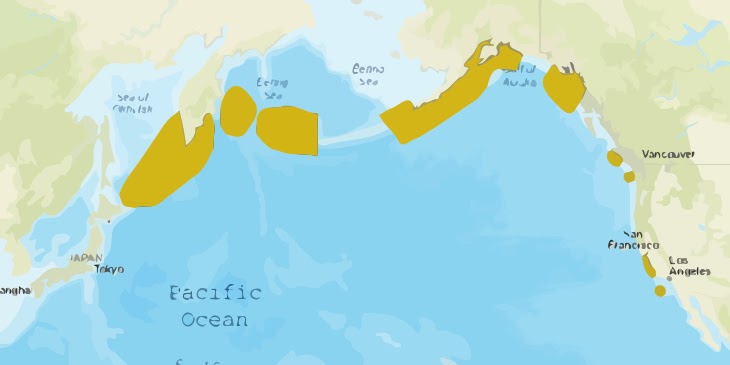
The North American River Otter has a very large range and can be found throughout most of the US (the map below isn't quite accurate, we'll be creating a more accurate map, it is not found in very arid regions). It's habitat overlaps with the sea otter along the west coast of the US.

There are TONS (if you could weigh content on the internet ;) ) of videos "out there" of North American River Otters! GO! ENJOY!!! (but in the mean time, here are a few from us!)
Let's just start with this...
If you want more in-depth reading a few research articles you could explore on these otters includes:
> Genetic variation among populations of river otters in North America: considerations for reintroduction projects, TL Serfass, RP Brooks, JM Novak. Journal of Mamm., 1998
> Deciphering ecological barriers to North American river otter (Lontra canadensis) gene flow in the Louisiana landscape, EK Latch, DG Scognamillo, JA Fike. Journal of Am Gen, 2008
> Ten new polymorphic microsatellite loci for North American river otters (Lontra canadensis) and their utility in related mustelids, AS Beheler, JA Fike, G Dharmarajan. Molecular Ecology, 2005
> Characterization of basal seminal traits and reproductive endocrine profiles in North American river otters and Asian small‐clawed otters, HL Bateman, JB Bond, M Campbell, M Barrie. Zoo …, 2009
> Perfluorooctanesulfonate and related fluorinated hydrocarbons in mink and river otters from the United States, K Kannan, J Newsted, RS Halbrook. Environmental science & ACS Publ, 2002
> Prey selection by marine-coastal river otters (Lontra canadensis) in Newfoundland, Canada, D Cote, HMJ Stewart, RS Gregory. Journal of Mamm, 2008