Showing posts with label behavior. Show all posts

Thursday, January 26, 2017

Marine Otter - Basics

Marine Otter
(Lontra felina)


The posts this week are brief overviews of EACH of the otter species, focusing on recent information about each species and a vid or 2... 
 
This otter is second only to the sea otter in it's use of marine environments, only occasionally traveling up freshwater rivers in search of food. 


Marine Otters seem to be the only otter other than the sea otter that do not require access to fresh water to wash themselves. Though Marine Otters tend to be solitary, they are generally friendly (but not highly sociable) with other otters. They do sometimes hunt cooperatively, groups of two or three otters working together to catch larger fish. Also, Marine Otters have hairy noses! (Also known as the Sea Cat)


Status: Endangered and Decreasing


Marine Otters (distribution shown in yellow on the map to the left) live along the west coast of South America, from Peru to Chile, with a few noted "around the corner" in Argentina.


They tend to live in diversity rich areas along rocky shores with caves.


The habitat range of the Marine Otter overlaps in Chile with the other "most southerly" Lontra-otter, the South American River otter.


Videos of these agile little otters in the water are amazing to watch!


and on a rocky shore...


If you want more in-depth reading a few research articles you could explore on these otters includes:


>   Non-invasive genetic analysis reveals high levels of mtDNA variability in the endangered South-American marine otter (Lontra felina), Juan Valqui, Günther B. Hartl, Frank E. Zachos, 2010
>   Phylogeography of the marine otter (Lontra felina): historical and contemporary factors determining its distribution, JA Vianna, P Ayerdi, G Medina-Vogel. Journal of Am Genetic Assoc, 2010>   The marine otter Lontra felina (): A review of its present status and implications for future conservation,J Valqui - Mammalian Biology-Zeitschrift für Säugetierkunde, 2012
>   The late Miocene radiation of modern Felidae: a genetic assessment,WE Johnson, E Eizirik, J Pecon-Slattery, 2006




Sea Otter - The Basics

Sea Otter
(Enhydra lutris)


As promised, the posts this week are brief overviews of EACH of the otter species, focusing on recent information about each species and a vid or 2...
This species lives in the ocean, along the coast of the North pacific, enjoy! :)


Sea Otters spend their entire lives in the ocean, only leaving the water in the case of extremely bad storms. They are also one of the known tool-using mammals, using rocks to break shells open so they can consume the shellfish inside. It is important that they are able to do this well because they have to eat about 30% of their body weight every day!


Status: Endangered and Decreasing


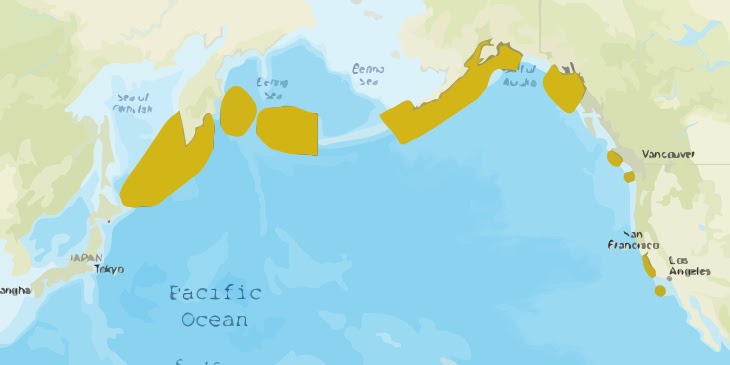
The Sea Otter range traditionally rimmed the outlying land/islands of the northern Pacific Ocean from Baja Mexico around Japan; currently they are restricted to the sporadic range shown in tan below.


Sea Otters at Seattle Aquarium, eating, playing, cleaning, and watching the tourists!


Live WILD Sea Otter mom giving birth near Monterey Bay Aquarium


PBS's NATURE on Sea Otters

Another PBS documentary, thsi time from Jean-Michel Cousteau!


If you want more in-depth reading a few research articles you could explore on these otters includes:

CK Johnson, MT Tinker, JA Estes… - Proceedings of the …, 2009 - National Acad Sciences
>   Southern sea otter as a sentinel of marine ecosystem health,DA Jessup, M Miller, J Ames, M Harris, C Kreuder… - EcoHealth, 2004 - Springer
>   Foraging patterns and prey selection in an increasing and expanding sea otter population,KL Laidre, RJ Jameson - Journal of Mammalogy, 2006 - BioOne
> Gene transcription in sea otters (Enhydra lutris); development of a diagnostic tool for sea otter and ecosystem health, L Bowen, AK Miles, M Murray… - Molecular ecology …, 2012