Showing posts with label facts. Show all posts

Thursday, January 26, 2017

Neotropical Otter - Basics

Neotropical Otter
(Lontra longicaudis)


As promised, the posts this week are brief overviews of EACH of the otter species, focusing on recent information about each species and a vid or 2...
Neotropical Otters latin name (Lontra longicaudis) means Otter with looong tail! 
I hope that you enjoy exploring them!


Unlike most otter species, Neotropical Otters are relatively solitary and are very elusive even in pristine habitats. Male and female Neotropical Otters meet one day a year for breeding, and then go their separate ways. Neotropical Otters prefer clear, fast-flowing water. Habitat destruction and water pollution are major threats to this species.


Status: Near Threatened and Decreasing
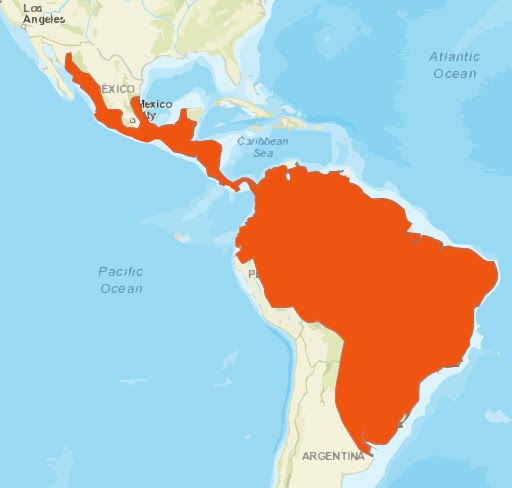


Neotropical Otters are found through most of Mexico all the way south to Argentina (except in arid regions). It's habitat range approaches the North American River Otter to the north and the South American River Otter to the south.


This species occurs in it's range from sea level to 4,000 meters (over 13,000 feet altitude).


This species is very shy and elusive,s o getting good videos isn't easy!

A couple of Neotropical Otters together (wild)


Neotropical Otter videos, swimming and grooming (in captivity)


If you want more in-depth reading a few research articles you could explore on these otters includes:

>   Trophic ecology and the use of shelters and latrines by the Neotropical otter (Lontra longicaudis) in the Taquari Valley, Southern Brazil, CB Kasper, VAG Bastazini, J Salvi. Iheringia. Série, 2008
O Carvalho-Junior, AB Birolo. IUCN Otter Spec., 2010
>   Seasonal and spatial differences in feeding habits of the Neotropical otter Lontra longicaudis (Carnivora: Mustelidae) in a coastal catchment of southeastern. ML Rheingantz, HF Waldemarin, L Rodrigues.  Zoologia , 2011
>   Defining Neotropical otter Lontra longicaudis distribution, conservation priorities and ecological frontiers, ML Rheingantz, JFS de Menezes. Tropical Conservation, 2014

South American River Otter - Basics!

South American /Southern River Otter 
(Lontra provocax)


The posts this week are brief overviews of EACH of the otter species, focusing on recent information about each species and a vid or 2... 
 
This otter shares large parts of it's the marine otter's marine habitat. 


Southern River Otters tend to have a very short life span. Few live to maturity, and only 1% live to 10 years of age. They are generally solitary, coming together mainly to mate. The female raises the pups alone, and there are no social groups beyond this.   They have territories like other otters, but the size of these territories is unknown and it appears that they are not particularly defensive of them.

Status: Endangered and Decreasing


South American River otters live in fresh and salt water habitats along the lower (primarily western) coast of South America, in red in the map on the left.


The habitat range of the Marine Otter overlaps in Chile with the other "most southerly" Lontra-otter, the South American River otter.


Southern River otter in captivity, eating.


If you want more in-depth reading a few research articles you could explore on these otters includes:

>   Understanding the inter-specific dynamics of two co-existing predators in the Tierra del Fuego Archipelago: the native southern river otter and the exotic American. AEJ Valenzuela, AR Rey, L Fasola, A Schiavini - Biological invasions, 2013
D Centrón, B Ramirez, L Fasola… - Journal of Am Genetic Assoc, 2008
>   Phylogeography of the Patagonian otter Lontra provocax: adaptive divergence to marine habitat or signature of southern glacial refugia? JA Vianna, G Medina-Vogel, BMC, 2011


Marine Otter - Basics

Marine Otter
(Lontra felina)


The posts this week are brief overviews of EACH of the otter species, focusing on recent information about each species and a vid or 2... 
 
This otter is second only to the sea otter in it's use of marine environments, only occasionally traveling up freshwater rivers in search of food. 


Marine Otters seem to be the only otter other than the sea otter that do not require access to fresh water to wash themselves. Though Marine Otters tend to be solitary, they are generally friendly (but not highly sociable) with other otters. They do sometimes hunt cooperatively, groups of two or three otters working together to catch larger fish. Also, Marine Otters have hairy noses! (Also known as the Sea Cat)


Status: Endangered and Decreasing


Marine Otters (distribution shown in yellow on the map to the left) live along the west coast of South America, from Peru to Chile, with a few noted "around the corner" in Argentina.


They tend to live in diversity rich areas along rocky shores with caves.


The habitat range of the Marine Otter overlaps in Chile with the other "most southerly" Lontra-otter, the South American River otter.


Videos of these agile little otters in the water are amazing to watch!


and on a rocky shore...


If you want more in-depth reading a few research articles you could explore on these otters includes:


>   Non-invasive genetic analysis reveals high levels of mtDNA variability in the endangered South-American marine otter (Lontra felina), Juan Valqui, Günther B. Hartl, Frank E. Zachos, 2010
>   Phylogeography of the marine otter (Lontra felina): historical and contemporary factors determining its distribution, JA Vianna, P Ayerdi, G Medina-Vogel. Journal of Am Genetic Assoc, 2010>   The marine otter Lontra felina (): A review of its present status and implications for future conservation,J Valqui - Mammalian Biology-Zeitschrift für Säugetierkunde, 2012
>   The late Miocene radiation of modern Felidae: a genetic assessment,WE Johnson, E Eizirik, J Pecon-Slattery, 2006