Showing posts with label science. Show all posts

Monday, November 18, 2019

Yes, QuestX is moving!

 QuestX blog is in the process of moving over to QuestX.net   /   QuestX.net/blog !


We're in the process of updating the website and consolidating the blog on to our web page.
It will take us some time to get this all up to date, I'm hoping by Jan., 2020!

Please excuse our mess while we get this all sorted through and cleaned up.

A lot has been going on and we'll have loads to share with you later this year...
...stay in touch with us for upcoming adventures, events, podcasts, videos, activities, research, outings, news, curiosities, and other science "stuff"!

Currently, QuestX's "drop in" experiment page is at questx.net , "home" page , and "about/staff" page.

oh! ...and for some reason Firefox does not like the current web page set up and does not consistently work for our site, we'll be sorting that out too!  (the other browsers seem to work fine...)


…for more QuestX :
QuestX is also on Google+ / YouTube (QuestX), Facebook(@QuestX.net), & Twitter (@QuestX1)

Friday, March 31, 2017

Badger caches cow...


Wait! ... What?!?

Yep... scientists researching the ecology of scavengers (in other words> studying how animals that feed on dead animal or plant matter interact with each other and their environments) during winter in the Great Basin Desert, Utah, staked out 7 calf carcasses (each with an associated trap camera) and got an unexpected result...
Badgers!
Scientific researchers in Great Basin Desert, Utah, caught American badgers (on trap cameras) caching cows.
While badgers are known scavengers, the researchers hadn't planned on studying any mustelids, including badgers.


Badgers are hard to study since they are generally active underground or are nocturnal (out and about at night), so their behaviors aren't well-known. Last winter (January, 2016) the researchers caught two badgers (images, not the badgers themselves! ; ) caching two of the staked out carcasses. This is the first evidence of a badger caching / burying an animal larger than itself.

Here is a video (from a trap camera) of one of those badgers caching /burying it's find for later:


updating soon...


The original video is on YouTube!

For the research article:
.
 Subterranean caching of domestic cow (Bos taurus) carcasses by American badgers (Taxidea taxus) in the Great Basin Desert, Utah


Friday, February 17, 2017

Backyard Bird Count Day #1 - report


Not all of the reports are in yet for the first day of The Great Backyard Bird Count (GBBC), but by the end of the first day (a *day* is measured by E.S.T) there were about 30,000 checklists reported in! 
The ~snap below is with about 15 minutes left to go in the first *day* of reporting...


...and *here* (below) is a good start to the second *day* of reporting!
54 seconds in to *Day* 2...


As you can see, now, people from all over the world participate! Last year over 160,000 people in over 130 countries participated.

There are still THREE (3) days left to go, and you can participate in as little as 15 minutes!

For more information on how to participate, check out the Getting Started page. You'll find a link for setting up a reporting page, access to birding tips and techniques, bird identification (including audio, because sometimes you don't see the birds! ; ) ...
... there's a Photo Contest... 
 
AND,  you get to be a citizen scientist!
 
...contributing meaningful data
with thousands of others
to better understand our world... 


Personal Notes: Today we had very limited time, so participated for about an hour.
We saw 9 species: Great Blue Heron, Red-tailed Hawk, Steller's Jay, Robin, Mourning Dove, Bewick's Wren, Back-capped Chickadee, Crow, and Red-winged Blackbird.
We'll load a data collection sheet that we like to use, which you can copy or use for ideas to make your own   ; )
We'll post some pics and/or vid tomorrow!


Thursday, February 16, 2017

Participate!!! Great Backyard Bird Count 2017! (20th annual GBBC)

The Great Backyard Bird Count is a science event that everyone can participate in... even from a chair looking out your window!

(the video below was taken from my deck, beware the door squeak!)

Great Blue Heron in Cedar Tree 
When? From Friday, Feb. 17, to Monday, Feb. 20, 2017, for as little as 15 minutes at a time OR as long as you want over the 4 day event.
Where? Wherever you are! From looking out your window to trekking through the woods, across a prairie, sitting in your car at park/ riverside... or wherever you are...
Why? To help understand bird populations (and, really, our world) better!
How? Go to GBBC 2017 and sign up to report your bird sightings! It's *even* easier than it sounds (check back here too, Quest will be posting some bird silhouette identification pages that will help to make identification easier for some birders and more info on birding/ participation).  We suggest that you register a.s.a.p. and review the entry form, that way you have a better idea of what to watch for! (it's good to note day, time, weather, etc.)
"The Great Backyard Bird Count (GBBC) is a free, fun, and easy event that engages bird watchers of all ages in counting birds to create a real-time snapshot of bird populations. Participants are asked to count birds for as little as 15 minutes (or as long as they wish) on one or more days of the four-day event and report their sightings online at birdcount.org. Anyone can take part in the Great Backyard Bird Count, from beginning bird watchers to experts, and you can participate from your backyard, or anywhere in the world.
Each checklist submitted during the GBBC helps researchers at the Cornell Lab of Ornithology and the National Audubon Society learn more about how birds are doing, and how to protect them and the environment we share. Last year, more than 160,000 participants submitted their bird observations online, creating the largest instantaneous snapshot of global bird populations ever recorded.
The 20th annual GBBC will be held Friday, February 17, through Monday, February 20, 2017. Please visit the official website at birdcount.org for more information and be sure to check out the latest educational and promotional resources."


Thursday, January 26, 2017

Neotropical Otter - Basics

Neotropical Otter
(Lontra longicaudis)


As promised, the posts this week are brief overviews of EACH of the otter species, focusing on recent information about each species and a vid or 2...
Neotropical Otters latin name (Lontra longicaudis) means Otter with looong tail! 
I hope that you enjoy exploring them!


Unlike most otter species, Neotropical Otters are relatively solitary and are very elusive even in pristine habitats. Male and female Neotropical Otters meet one day a year for breeding, and then go their separate ways. Neotropical Otters prefer clear, fast-flowing water. Habitat destruction and water pollution are major threats to this species.


Status: Near Threatened and Decreasing


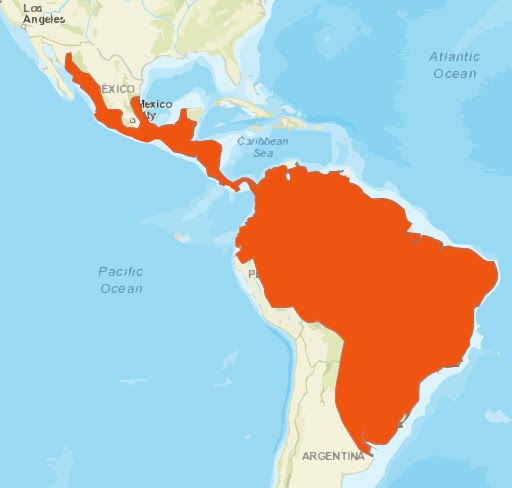
Neotropical Otters are found through most of Mexico all the way south to Argentina (except in arid regions). It's habitat range approaches the North American River Otter to the north and the South American River Otter to the south.


This species occurs in it's range from sea level to 4,000 meters (over 13,000 feet altitude).


This species is very shy and elusive,s o getting good videos isn't easy!

A couple of Neotropical Otters together (wild)


Neotropical Otter videos, swimming and grooming (in captivity)


If you want more in-depth reading a few research articles you could explore on these otters includes:

>   Trophic ecology and the use of shelters and latrines by the Neotropical otter (Lontra longicaudis) in the Taquari Valley, Southern Brazil, CB Kasper, VAG Bastazini, J Salvi. Iheringia. Série, 2008
O Carvalho-Junior, AB Birolo. IUCN Otter Spec., 2010
>   Seasonal and spatial differences in feeding habits of the Neotropical otter Lontra longicaudis (Carnivora: Mustelidae) in a coastal catchment of southeastern. ML Rheingantz, HF Waldemarin, L Rodrigues.  Zoologia , 2011
>   Defining Neotropical otter Lontra longicaudis distribution, conservation priorities and ecological frontiers, ML Rheingantz, JFS de Menezes. Tropical Conservation, 2014

South American River Otter - Basics!

South American /Southern River Otter 
(Lontra provocax)


The posts this week are brief overviews of EACH of the otter species, focusing on recent information about each species and a vid or 2... 
 
This otter shares large parts of it's the marine otter's marine habitat. 


Southern River Otters tend to have a very short life span. Few live to maturity, and only 1% live to 10 years of age. They are generally solitary, coming together mainly to mate. The female raises the pups alone, and there are no social groups beyond this.   They have territories like other otters, but the size of these territories is unknown and it appears that they are not particularly defensive of them.

Status: Endangered and Decreasing


South American River otters live in fresh and salt water habitats along the lower (primarily western) coast of South America, in red in the map on the left.


The habitat range of the Marine Otter overlaps in Chile with the other "most southerly" Lontra-otter, the South American River otter.


Southern River otter in captivity, eating.


If you want more in-depth reading a few research articles you could explore on these otters includes:

>   Understanding the inter-specific dynamics of two co-existing predators in the Tierra del Fuego Archipelago: the native southern river otter and the exotic American. AEJ Valenzuela, AR Rey, L Fasola, A Schiavini - Biological invasions, 2013
D Centrón, B Ramirez, L Fasola… - Journal of Am Genetic Assoc, 2008
>   Phylogeography of the Patagonian otter Lontra provocax: adaptive divergence to marine habitat or signature of southern glacial refugia? JA Vianna, G Medina-Vogel, BMC, 2011


Marine Otter - Basics

Marine Otter
(Lontra felina)


The posts this week are brief overviews of EACH of the otter species, focusing on recent information about each species and a vid or 2... 
 
This otter is second only to the sea otter in it's use of marine environments, only occasionally traveling up freshwater rivers in search of food. 


Marine Otters seem to be the only otter other than the sea otter that do not require access to fresh water to wash themselves. Though Marine Otters tend to be solitary, they are generally friendly (but not highly sociable) with other otters. They do sometimes hunt cooperatively, groups of two or three otters working together to catch larger fish. Also, Marine Otters have hairy noses! (Also known as the Sea Cat)


Status: Endangered and Decreasing


Marine Otters (distribution shown in yellow on the map to the left) live along the west coast of South America, from Peru to Chile, with a few noted "around the corner" in Argentina.


They tend to live in diversity rich areas along rocky shores with caves.


The habitat range of the Marine Otter overlaps in Chile with the other "most southerly" Lontra-otter, the South American River otter.


Videos of these agile little otters in the water are amazing to watch!


and on a rocky shore...


If you want more in-depth reading a few research articles you could explore on these otters includes:


>   Non-invasive genetic analysis reveals high levels of mtDNA variability in the endangered South-American marine otter (Lontra felina), Juan Valqui, Günther B. Hartl, Frank E. Zachos, 2010
>   Phylogeography of the marine otter (Lontra felina): historical and contemporary factors determining its distribution, JA Vianna, P Ayerdi, G Medina-Vogel. Journal of Am Genetic Assoc, 2010>   The marine otter Lontra felina (): A review of its present status and implications for future conservation,J Valqui - Mammalian Biology-Zeitschrift für Säugetierkunde, 2012
>   The late Miocene radiation of modern Felidae: a genetic assessment,WE Johnson, E Eizirik, J Pecon-Slattery, 2006


Thursday, December 8, 2016

The Coelenterates, A Scientific Controversy...


To coelenterate or not to coelenterate, that is the question...

Whether 'tis Nobler in the nomenclature to correlate
The Threads and Barbs of nematocysts,
With the colloblasts of the ctenophores,
And by opposing end their correlation: to declassify, to reclassify
No more; and by classify, to say we reorganize
The Heart-ache, and the thousand Natural shocks
That gelatinous bodies are heir to? 'Tis a re-classification
Devoutly to be wished. To declassify, to reclassify,
To reclassify, perchance to genetically code; aye, there's the rub,
For in that coding, what truth may come,
Comprehending these evolutionary differences,
Must give us pause. There's the respect
That makes Joy of so long life...

(with deepest apologizes to The Bard)


Science is active, it is about observing, testing, considering, and refining. With Science we learn additional information and refine our perspectives, the case of the cnidarians and the ctenophores is an excellent example; Science utilizes the method of using our best-current-facts to comprehend the world around us. Our ability to *see* the natural world around us changes greatly over time due to advancing technologies (microscopes, telescopes, genetic coding, etc.) and of course the effect of standing-on-the-shoulders-of-those-that-went-before (discovery builds on discovery, comprehension on comprehension... ).

E. Haeckel- Cnidaria
To quote- science is "the intellectual and practical activity encompassing the systematic study of the structure and behavior of the physical and natural world through observation and experiment"... Anyone can do it, but Science demands from the *researcher/observer* open-ness not only to new ideas but to being able to follow the evidence where it leads and acknowledge changes/updates in information.

So... what does this have to do with our coelenterate controversy?

...any excuse for a Haeckel! Ctenophora
Cnidarians (anemones, corals, and jellyfish) and ctenophores (comb jellies) *used to* be categorized in the same Phylum, Coelenterata; both are very simply structured, gelatinous-bodied, and lack a backbone (invertebrate). BUT! research over time (which is *how* research happens : ) has shown that the differences between the cnidarians and the ctenophores are substantial enough to place them in separate phyla: Coelenterata (a.k.a Cnidaria) and Ctenophora; because of some similarities and a history of grouping them together the two phyla are sometimes still colloquially (non-scientifically) grouped together for convenience and called coelenterates (so, be gentle, sometimes change takes time! ;)  ).


So, what are some of those differences which led scientists to go to the lengths of creating a whole new PHYLUM?!?
(and how the heck do you pronounce coelenterate, cnidaria (UK), and ctenophore anyway?!?)


Cnidarians (Coelenterates)
Ctenophores
Symmetry -body
Radial
Bi-radial
Digestive tract
Incomplete (single) digestive opening, food enters and leaves the body through the same opening
Complete (one way) digestive tract with 2 openings: oral (mouth) and anal.
Prey capture
*Stinging cells- cnidocytes/ nematocysts
Sticky cells- colloblasts
Larval form
Planula
Cydippid
Development
Diploblastic, with true tissue
Triploblastic

(by the way, any terms/words you are uncertain of can easily be found online! I’m in a rush today! : )


*Those stinging cells are key by the way!

It appears that cnidarians are more directly in-line evolutionarily, and that the ctenophores are more of a sibling group to all other animals. Ctenophores have muscle and nervous systems that seem to have evolved independently from other modern animals (google Hox and Homeotic gene contingents!). Where the ctenophores sit in their forms and functions excluded them from being grouped in the Phylum Coelenterata.

So, you see, what some people may think of as a negative, "controversy", Science sees as normal growth and development. We start with basic information, and then, based on observation, testing, and consideration we develop and refine the information. Since our abilities and technologies improve our ability to perceive more of the natural world improves also; consider the path to what we know about genetics ...
Double Helix
...in 1866, the monk, Gregor Mendel published a paper based on his plant experiments (done in the garden of the monastery) that became the basis for the Mendelian laws of inheritance, Meischer published his first paper identifying "nuclein" (now called DNA) in the cell nucleus in 1871 (without the microscope *that* would have been rather impossible), 1900 Mendel's work was rediscovered by several researchers (confirming their work), in 1910 Kossell received the first Physiology/ Medicine Nobel Prize based on the discovery of the 5 nucleotide bases (go google that, it's something you should know!), Hershey and Chase demonstrated that DNA carries our genetic material in 1952, 1953 was the "discovery" of the double helix (yeah, the double helix was always there, but until we could "see" it we couldn't *see* it! ... y'know?), in 1977 Sanger developed a sequencing technique to sequence (read) the first full genome (the complete set of genes in an organism), 1990 saw the launch of The Human Genome Project (yes, that would be the sequencing/reading of ALL of the genes in a human), in 2001 the first draft of the human genome was released with the project completed in 2003 (to 99.99% accuracy and 2 years early), in 2008 due to technological advancements the costs of genetic sequencing drops with the development of next-generation sequencing platforms, the first comprehensive analysis of cancer genomes is published in 2009...


...and one of the RESULTs of all of that scientifically acquired knowledge? Modern medicine that allows targeted treatment of many genetics illnesses.

Science builds on *small* steps...
... ok, sometimes we get lucky and we get a big step, but you know what I mean...

And we *still* have a lot to learn about genetics!

This is how science is supposed to function, always improving on it's self, and how we see our world.