Showing posts with label fossil. Show all posts

Sunday, February 12, 2017

Major Influences on Charles Darwin’s Evolution


Charles Darwin
Charles Darwin presented the concept of evolution by natural selection to the world in 1859, when he published his classic On the Origin of Species. In honor of Darwin Day (February 12, 2016) I would like to discuss the evolution of (Darwin’s) evolution, and highlight some of the disparate influences in Darwin’s life that led to publication of one of the most powerful ideas in biology.
Evolution per se was not a new idea in Darwin’s time. In the late 1700’s and early 1800’s, several figures in particular developed concepts central to the current view of evolution.  

·         Georges Cuvier (1744-1829) –The notable natural historian Georges Cuvier (for whom the Cuvier’s beaked whale is named) was the first to establish extinction as a fact. Prior to Cuvier, those who studied fossils assumed that they represented anomalous versions of extant animals, or animals that still lived in other parts of the world. Cuvier found fossils that did not match any living animals, and determined that species did, indeed, go extinct.

·         Jean Baptiste Lamarck (1769-1832) – Lamarck studied animals and fossils from around the world. This study led him to the same overall conclusion as Darwin. That is, that species vary over time in response to changes in the environment. With enough time, nature will develop species to fit every environment. He lacked the details to flesh out his ideas, and his theories were attacked by other scientist of the day. However, to Charles Darwin these concepts were so influential that in 1861 he wrote: 

Lamarck was the first man whose conclusions on the subject excited much attention. This justly celebrated naturalist first published his views in 1801. . . he first did the eminent service of arousing attention to the probability of all changes in the organic, as well as in the inorganic world, being the result of law, and not of miraculous interposition.

·         Erasmus Darwin (1731-1802) – Although Charles Darwin never met his grandfather Erasmus Darwin, he was strongly influenced by his work and read his papers and poetry. Erasmus was a social liberal and a free-thinker. A physician by trade, he refused an invitation by King George III to become the Royal Physician, preferring instead to work with the poor in his community. He promoted social equality, and proposed that women should receive a proper education, including studies in physical education, the sciences, and the arts. His ideas of evolution were so close to those of Lamarck that it’s hard to believe the two never met. He wrote his ideas in both prose and poetry. Yes, he set his evolutionary ideas to rhyme and verse. You can check out some of his poetry at www.poemhunter.com/erasmus-darwin/.

Charles Darwin was himself was born in 1809, the son of a physician. He was expected to become a physician himself, and entered medical school in Edinburgh in 1825. It was in medical school that his father gave him his grandfather’s papers to study, inadvertently exposing him to evolutionary ideas. He found he was too squeamish for the medicine of the day, however, and left medical school in 1827. His real passion was natural history, and in 1828 he enrolled in Christ’s College in Cambridge to pursue a degree in his chosen field. While in school, he spent his extra time hunting and collecting insects. These were skills he would put to good use later in life. He graduated in 1831.
Shortly after graduating, he was offered the position of ship’s naturalist on the HMS Beagle, a Royal Naval ship commissioned to study the biology and geology of South America. Darwin served on the Beagle from 1831 to 1836. The captain of the ship, Robert FitzRoy, introduced Darwin to the work of Charles Lyell, another great influence in Darwin’s life.

·         Charles Lyell (1797-1875) – Lyell was a prominent geologist who wrote the book Principles of Geology. In this book, Lyell presented his idea that the world is not static, and that geology is the result of slow, continuous processes. At this time, fossil patterns and large scale geological features were explained largely by biblical events, such Noah’s flood. Lyell proposed instead that these features weren’t based on distinct biblical cataclysms, but on the cumulative effects of well-known processes. This planted in Darwin’s mind the idea that biological processes might also be based on slow cumulative changes, rather than cataclysmic events. In other words, large changes between species didn’t have to occur all at once, but could proceed through a slow series of continuous changes.

While on the Beagle, Darwin collected specimens, fossils, and notes that he would analyze and interpret for years to come. In the years between his return from the Beagle voyage and the publication of Origin of the Species, there were many factors that helped lead Darwin to his conclusions on evolution.  This article will only discuss a few of them.

Thomas Malthus
·         Thomas Malthus (1766-1834) – In 1798, Malthus published his Essay on the Principle of Population. In this article, Malthus observed that plants and animals produce more offspring than can survive naturally. Humans also have the capacity to overproduce, and left unchecked populations could grow unsustainably. Darwin came across this article in 1838 and applied it to his developing ideas on evolution. He reckoned that if animals produced more offspring than could survive, the offspring that survived should have some advantage over those that didn’t. That is, there had to be some force to determine which offspring lived and which ones died. He called this force natural selection.

·         Artificial Selection – There was no way at that time for Darwin to test his ideas. Instead, he turned to the literature on selective breeding of plants and animals. He observed that different breeds of plants and animals could be produced by selectively
Alfred R. Wallace
      breeding parents most strongly demonstrating the characteristics you want in the offspring.  He reckoned that there was some inherent variability for each characteristic available to each generation. By reinforcing desired characteristics by only breeding parents demonstrating that character, you could reduce the variability for that characteristic, thus creating specific breeds with specific characteristics. He coined the term Artificial Selection  to distinguish it from Natural Selection, which is the corresponding pressure nature exerts on species to help them adapt to changing conditions.

·         Alfred Russel Wallace (1823-1913) – In 1858, Wallace sent a letter to Darwin asking for him to review a manuscript he was preparing on the topic of evolution. As frequently happens in science, he developed a concept of evolution very similar to Darwin’s, and he wanted Darwin to review it and let him know if it was worth publishing.  Wallace published his paper in 1858, alongside one of Darwin’s papers. The papers Darwin and Wallace published received little attention from the scientific community, but it was enough to prompt Darwin to write his seminal book, On the Origin of Species.

 
On the Origin of Species, Charles Darwin, 1859.
On the Origin of Species is one of the most influential books in biology, and underpins all modern research in ecology, natural history, medicine, and all other biological fields. As we honor Charles Darwin on this day, I think it’s important to remember that Darwin was not just a natural historian. He integrated ideas from natural history, geology, social economy, and more. The best science is truly an interdisciplinary endeavor!


Thursday, November 24, 2016

Evolution Day Meets Thanksgiving Day (or the progress of the turkey ;)

This year Evolution Day (the anniversary of the public of "The Origin of Species" by Charles Darwin) falls on the same day as the US National Holiday of Thanksgiving, so it *only* seems right to take a nod at the turkey!


Friday, February 12, 2016


Happy Darwin Day!!!!


Today is Charles Darwin's 207th birthday, and seems like an absolutely perfect day to really get Quest off the ground.

As we all know, Charles Darwin was the father of modern evolutionary biology. Darwin wasn't responsible for the idea that life changes over time, but he (well, and Alfred Russel Wallace, but it's not his birthday!) was responsible for proposing and supporting the theory of evolution by natural selection (or as you may have heard of it, "survival of the fittest") and many of the mechanisms by which we know evolution to work.


You have probably heard about Darwin and his finches, but have you heard of Darwin's fossils? As an evolutionary and quasi-paleobiologist, I think it is important to take a moment to appreciate the contributions of Charles Darwin's "geologizing" to the birth of modern evolutionary biology. It is quite possible (and I think quite likely) that this is part of why he got it right where others did not. As Theodosius Dobzhansky said, "Nothing in biology makes sense except in the light of evolution". I'm not saying that evolution only occurs over geologicc timescales, or that that is the only place to study it, just that the power of evolutionary mechanisms at creating differentiation is best appreciated over such timescales. Luckily, in the geology department, Darwin really knew his schist.

On the voyage of the Beagle, Charles Darwin described many organisms that were previously unknown to science, but he didn't stop with living fauna. On the coast of South America he described fossils of, among other critters, nine <largely> undescribed extinct species of megafauna. What's interesting is that these critters were things like ground sloths, giant armadillos, capybaras, and camelids. Sloths and armadillos are both unique groups with very unusual features, as to varying degrees are the other fossils he encountered. Most of these were also relatives of critters that Darwin had been eating a lot in his time in South America, so he had seen a lot of the bones of the modern forms. It was through comparison of the fossil and living organisms that Darwin realized how strong a force evolution was and how what might be advantageous in one time and place might not be in another.

Here are some pictures of the extinct critters and their extant relatives that helped Darwin piece together the processes of evolution.


Megatherium (Paris Natural History Museum): a giant ground sloth

Does actually look a bit like this guy on the inside!


Or there's Glyptodon, an ancient genus of giant armadillo!


And our more familiar looking friend the nine-banded armadillo


If you would like to know more about Darwin, his contributions to paleontology and geology, or the voyage of the Beagle, here are some great resources!
-This is a particularly nice National Geographic essay: http://ngm.nationalgeographic.com/print/2009/02/darwin/quammen-text
-http://darwin-online.org.uk/
-http://blogs.scientificamerican.com/rosetta-stones/darwin-geologist-first-and-last/
-https://bioteaching.wordpress.com/2011/02/12/charles-darwin/

Saturday, March 30, 2013

Article: Giant Paleo-Otter from the Pliocene, from Dikika, Ethiopia

Article: Enhydriodon dikikae, sp. nov. (Carnivora: Mammalia), a Gigantic Otter from the
Pliocene of Dikika, Lower Awash, Ethiopia (link to complete article).

A partial skull, low jaw section, humerus, and some femur fragments found in the Afar Valley, Ethiopia, have been used to describe a previously undescribed species of ancient otter.
Geraads and colleagues state, "The most striking feature is its very large size", referring to the skull, which if proportioned like a modern otter would result in a skull 10 inches long. Estimating total size using the fossils found indicates an animal over 7 feet long, but these estimates would be very rough considering possible variations.


Saturday, February 9, 2013

Coastal Fossils- The Winter Collection #1 (1 of 2)


 ...continued from... Coastal Fossils - Gifts of the Winter Beach #3


We collected so many interesting fossils and agates during our winter excursion to the central Oregon coast [IBLs] that it will take a couple posts to share all of them! We'll separate them into 2 main groupings: 1) Moolack Beach and 2) Lost Creek Beach. Moolack Beach will be shared first since that is the smaller collection (and I've managed to photograph all of it already!  ; )

Individual finds/fossils will be explored further as we have time.

Right! Now on with viewing the collections...

The Moolack Beach Collection / Fossils


To the right is the entire collection from Moolack Beach (except the "finds" that includes the specimens photographed and left "in situ" (in place)).

As I said earlier, the collection from Moolack Beach is smaller than the Lost Creek collection, but it is an intriguing collection...
... and we'll save the most intriguing find for last, since it will take the most space to get a good look at it.


~~~~~~~~~~~~~~~~~~
#13-1_M1


< This is the largest of the concretions that we collected (upper left in the "group photo" ; )  on this excursion. It measures ~ 9 1/2" long.


Even at this stage you can easily see several different types of bivalves (clams), a couple gastropods, and two fossils that are showing up as a very different sort of fossil- "brown" (see one up close below).


This is the "left edge" of the piece shown above. I'm not absolutely sure what we are looking at here, but we'll get a better idea once we have a chance to look at it closer and start carefully removing the surrounding rock.
By the way, if you can identify any of the fossils being shown we'd love to hear from you!


~~~~~~~~~~~~~~~~~~
#13-1_M2


This smaller concretion has a lot of intriguing things going on; this piece has a lot of exposed crystalline structure, some interesting bivalves,


...and we'll be looking at these unusual (exposed)  structures to see what they are also... >


 ~~~~~~~~~~~~~~~~~~
#13-1_M3
 This concretion appears to be all bivalves...


~~~~~~~~~~~~~~~~~~
#13-1_M4


This concretion is about 6 1/2" long. We will leave some of these concretions "intact" in order to share what to look for on the beach when hunting fossil concretions!


~~~~~~~~~~~~~~~~~~
#13-1_M5


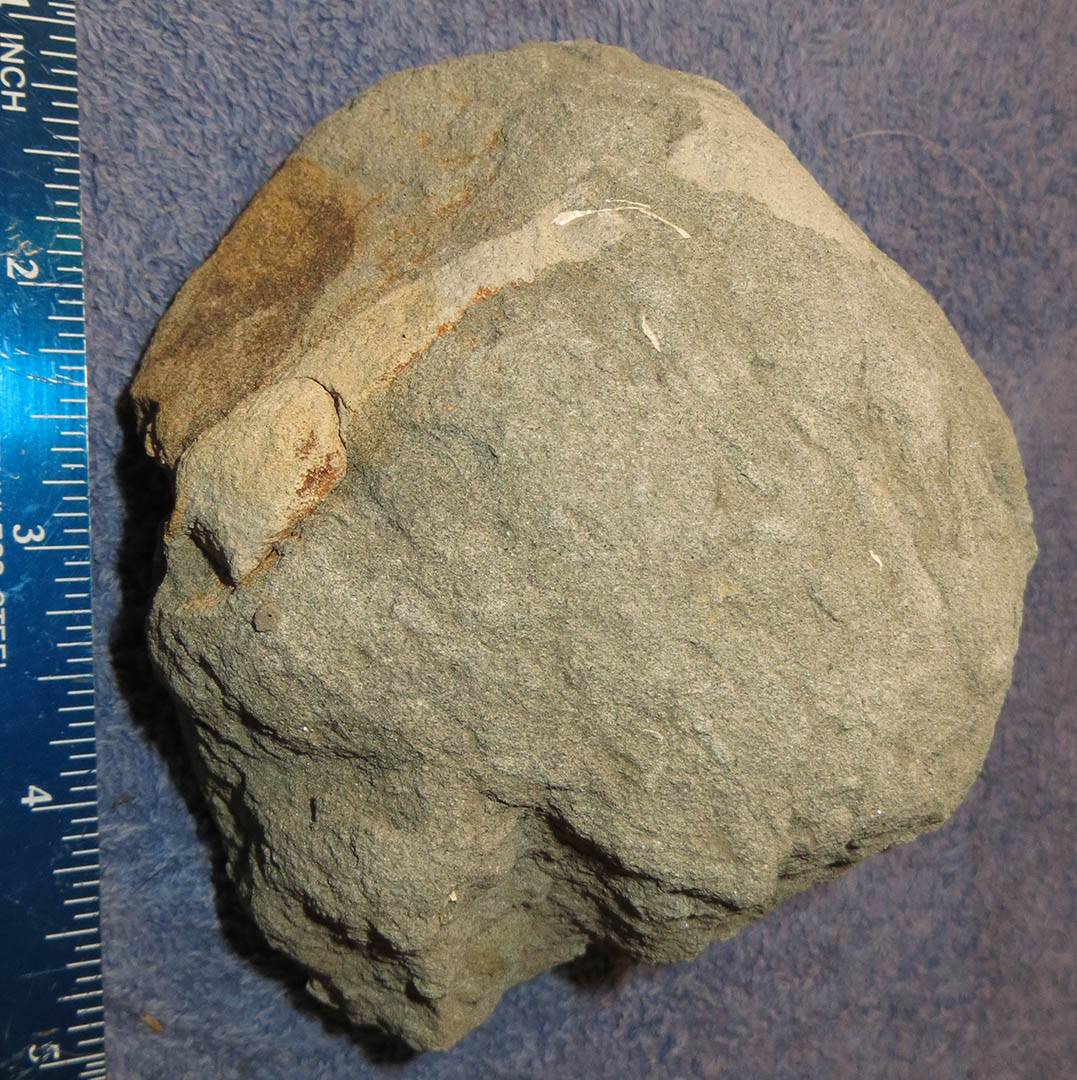
This fossil looks like it is likely bone, but we'll see! The fossil is in moderately delicate sandstone, which will make it easier to extract.


 ~~~~~~~~~~~~~~~~~~
#13-1_M6


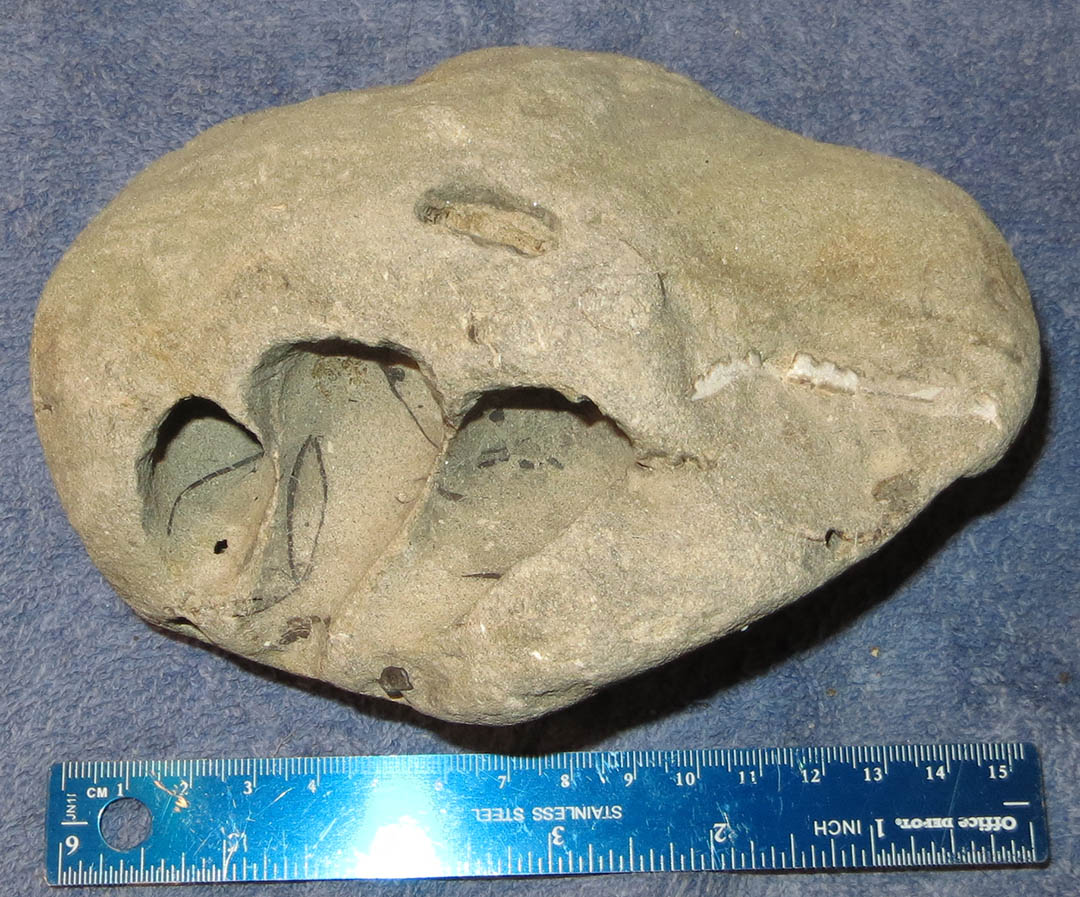
We also found some interesting mud stone type pieces. This one is particularly interesting since something has created/bored fairly large holes in the  mud stone (very hard mud stone in this case), including boring right through several fossils.

This one is very interesting "as is", so I doubt we will do much, if any, cleaning on it. 


.... sometimes you can get "help" ...


         ~~~~~~~~~~~~~~~~~~
         #13-1_M7/ 8/ 9/ 10/ 11

Several pieces with exposed shell.
~~~~~~~~~~~~~~~~~~
#13-1_M12


~~~~~~~~~~~~~~~~~~
#13-1_M13

Another concretion with assorted mollusc fossils.


~~~~~~~~~~~~~~~~~~
#13-1_M14/ 15/ 16

Small concretions with bivalve fossils.


Most of the following pieces have a fairly granular texture:

~~~~~~~~~~~~~~~~~~
#13-1_M17/ 18/ 19/ 20 


~~~~~~~~~~~~~~~~~~
#13-1_M21


~~~~~~~~~~~~~~~~~~
#13-1_M22/ 23/ 24


~~~~~~~~~~~~~~~~~~
#13-1_M25/ 26/ 24


The following pieces are agates or have some agate-like qualities:

~~~~~~~~~~~~~~~~~~
#13-1_M28/ 29/ 30/ 31/ 32/ 33


~~~~~~~~~~~~~~~~~~
#13-1_M34/ 35/ 36/ 37/ 38/ 39/ 40


~~~~~~~~~~~~~~~~~~
#13-1_M41


the most unique of our finds at Moolack Beach....
~~~~~~~~~~~~~~~~~~
#13-1_M42

This fossil ....


Join us in our ongoing Quest...
... continued in... Coastal Fossils- The Winter Collection #2 (2 of 2)[IBL]; the Lost Creek collection / fossils.