Showing posts with label ecology. Show all posts

Friday, March 31, 2017

Badger caches cow...


Wait! ... What?!?

Yep... scientists researching the ecology of scavengers (in other words> studying how animals that feed on dead animal or plant matter interact with each other and their environments) during winter in the Great Basin Desert, Utah, staked out 7 calf carcasses (each with an associated trap camera) and got an unexpected result...
Badgers!
Scientific researchers in Great Basin Desert, Utah, caught American badgers (on trap cameras) caching cows.
While badgers are known scavengers, the researchers hadn't planned on studying any mustelids, including badgers.


Badgers are hard to study since they are generally active underground or are nocturnal (out and about at night), so their behaviors aren't well-known. Last winter (January, 2016) the researchers caught two badgers (images, not the badgers themselves! ; ) caching two of the staked out carcasses. This is the first evidence of a badger caching / burying an animal larger than itself.

Here is a video (from a trap camera) of one of those badgers caching /burying it's find for later:


updating soon...


The original video is on YouTube!

For the research article:
.
 Subterranean caching of domestic cow (Bos taurus) carcasses by American badgers (Taxidea taxus) in the Great Basin Desert, Utah


Thursday, February 2, 2017

IT'S WORLD WETLANDS DAY (oh...am i shouting? ; )

I'm just really excited about World Wetlands Day!

World Wetlands Day celebrates the value of wetlands for humanity (and, really, ALL of the planet). Each year a new theme is chosen to raise awareness about the critical importance of wetland areas; the theme for 2017 is "Wetlands for Disaster Risk Reduction" ("to raise awareness and to highlight the vital roles of healthy wetlands in reducing the impacts of extreme events such as floods, droughts and cyclones on communities, and in helping to build resilience").


World Wetlands Day is celebrated (or starts) on this day because the Ramsar Convention was signed on this day (Feb.2) in 1971, in Ramsar, Iran.


Interested in participating this year but hearing about this too late to create or attend an event? Well, check our QuestX Calendar for other events (including Earth Day which is coming up soon) OR you could participate in the the Wetlands Youth Photo Contest (youth 18 - 25, see poster below)... or/and you can get an early start on next year's World Wetlands Day!


Here is a list of the countries/parties that have joined the Ramsar Convention, date joined, number of sites, and total area conserved. There are over 2,200 sites listed and over 530,000,000 (that's MILLION!) acres included:

~

Country Entry date Ramsar sites AREA-acres


Albania Feb-96 4 242,610
Algeria Mar-84 50 7,390,950
Andorra Nov-12 3 17,000
Antigua and Barbuda Oct-05 1 8,900
Argentina Sep-92 22 13,900,680
Armenia Nov-93 3 1,219,490
Australia Dec-75 65 20,559,560
Austria Apr-83 23 308,800
Azerbaijan Sep-01 2 246,000
Bahamas Jun-97 1 81,000
Bahrain Feb-98 2 16,800
Bangladesh Sep-92 2 1,510,000
Barbados Apr-06 1 82
Belarus Aug-91 20 1,692,029.20
Belgium Jul-86 9 116,001.30
Belize Aug-98 2 58,300
Benin May-00 4 2,914,250
Bhutan Sep-12 2 630
Bolivia (Plurinational State of) Oct-90 11 36,676,380
Bosnia and Herzegovina Mar-92 3 140,300
Botswana Apr-97 1 13,683,000
Brazil Sep-93 12 17,855,060
Bulgaria Jan-76 11 123,337.10
Burkina Faso Oct-90 15 1,612,370
Burundi Oct-02 4 194,010
Cambodia Oct-99 4 187,660
Cameroon Jul-06 7 2,043,700
Canada May-81 37 32,338,120
Cape Verde Nov-05 4 1,320
Central African Republic Apr-06 2 930,000
Chad Oct-90 6 30,653,590
Chile Nov-81 13 893,930
China Jul-92 49 10,162,019.90
Colombia Oct-98 6 1,751,196.10
Comoros Jun-95 3 39,600
Congo Oct-98 13 33,998,589.20
Costa Rica Apr-92 12 1,407,860
Côte d'Ivoire Jun-96 6 314,670
Croatia Jun-91 5 233,160
Cuba Aug-01 6 2,936,630
Cyprus Nov-01 1 2,740
Czech Republic Jan-93 14 148,770
Democratic Republic of Congo May-96 3 18,373,830
Denmark Jan-78 43 5,721,440
Djibouti Mar-03 1 7,400
Dominican Republic Sep-02 4 333,831.00
Ecuador Jan-91 18 708,330
Egypt Sep-88 4 1,026,800
El Salvador May-99 7 512,460
Equatorial Guinea Oct-03 3 340,000
Estonia Jul-94 17 753,120
Fiji Aug-06 1 1,520
Finland Dec-75 49 1,975,650
France Dec-86 44 8,815,199.00
Gabon Apr-87 9 6,964,590
Gambia Jan-97 3 77,210
Georgia Jun-97 2 85,200
Germany Jun-76 34 2,145,430
Ghana Jun-88 6 435,237.80
Greece Dec-75 10 404,020
Grenada Sep-12 1 1,280
Guatemala Oct-90 7 1,553,280
Guinea Mar-93 16 15,870,000
Guinea-Bissau May-90 4 2,939,647.60
Honduras Oct-93 9 667,740
Hungary Aug-79 29 634,930
Iceland Apr-78 6 317,940
India Feb-82 26 1,702,880
Indonesia Aug-92 7 3,392,700
Iran (Islamic Republic of) Dec-75 24 3,673,070
Iraq Feb-08 4 1,329,000
Ireland Mar-85 45 165,550
Israel Mar-97 2 900
Italy Apr-77 52 148,810
Jamaica Feb-98 4 93,520
Japan Oct-80 50 365,720
Jordan May-77 1 18,220
Kazakhstan May-07 10 8,108,510
Kenya Oct-90 6 655,940
Kiribati Aug-13 1 2,550
Kuwait Sep-15 1 125,900
Kyrgyzstan Mar-03 3 1,678,850
Lao People's Democratic Republic Oct-10 2 36,500
Latvia Nov-95 6 371,440
Lebanon Aug-99 4 2,660
Lesotho Nov-04 1 1,070
Liberia Nov-03 5 236,920
Libya Aug-00 2 210
Liechtenstein Dec-91 1 250
Lithuania Dec-93 7 162,050
Luxembourg Aug-98 2 42,530
Madagascar Jan-99 10 3,330,063
Malawi Mar-97 1 555,000
Malaysia Mar-95 6 331,510
Mali Sep-87 4 10,389,900
Malta Jan-89 2 40
Marshall Islands Nov-04 2 173,270
Mauritania Feb-83 4 3,066,000
Mauritius Sep-01 3 990
Mexico Nov-86 142 21,358,750.10
Monaco Dec-97 1 57
Mongolia Apr-98 11 3,557,200
Montenegro Jun-96 2 49,800
Morocco Oct-80 24 672,200
Mozambique Dec-04 2 11,205,910
Myanmar Mar-05 2 143,922.50
Namibia Dec-95 5 1,671,830
Nepal Apr-88 10 149,650
Netherlands Sep-80 54 2,233,168
New Zealand Dec-76 6 137,170
Nicaragua Nov-97 9 1,005,350
Niger Aug-87 12 10,669,690
Nigeria Feb-01 11 2,660,650
Norway Dec-75 63 2,198,010
Oman Aug-13 1 264
Pakistan Nov-76 19 3,320,170
Palau Feb-03 1 1,200
Panama Nov-90 5 454,650
Papua New Guinea Jul-93 2 1,470,090
Paraguay Oct-95 6 1,942,200
Peru Mar-92 13 16,763,730
Philippines Nov-94 6 381,550
Poland Mar-78 13 358,490
Portugal Mar-81 31 327,380
Republic of Korea Jul-97 21 46,020
Republic of Moldova Oct-00 3 234,020
Romania Sep-91 19 2,857,650
Russian Federation Feb-77 35 25,510,580

(ratified as Soviet Union)
Rwanda Apr-06 1 0
Saint Lucia Jun-02 2 210
Samoa Feb-05 1 1,200
Sao Tome and Principe Dec-06 1 57
Senegal Nov-77 5 247,090
Serbia Apr-92 10 157,950

(ratified as the Federal Republic of Yugoslavia)
Seychelles Mar-05 3 108,790
Sierra Leone Apr-00 1 730,000
Slovakia Jan-93 14 100,560
Slovenia Jun-91 3 20,270
South Africa Dec-75 22 1,373,110
South Sudan Oct-13 1 14,000,000
Spain Sep-82 74 749,000
Sri Lanka Oct-90 6 489,690
Sudan May-05 3 6,152,000
Suriname Nov-85 1 30,000
Swaziland Jun-13 3 0
Sweden Dec-75 66 1,610,340
Switzerland May-76 11 36,290
Syrian Arab Republic Jul-98 1 25,000
Tajikistan Nov-01 5 234,000
Thailand Sep-98 14 987,710
Former Yugoslav Republic of Macedonia Sep-91 2 53,410
Togo Nov-95 4 2,991,000
Trinidad and Tobago Apr-93 3 39,340
Tunisia Mar-81 41 2,076,580
Turkey Nov-94 14 455,880
Turkmenistan Jul-09 1 660,080
Uganda Jul-88 12 1,122,610
Ukraine Dec-91 33 1,840,070
United Arab Emirates Dec-07 5 50,110
United Kingdom May-76 170 3,160,290
United Republic of Tanzania Aug-00 4 12,030,140
United States of America Dec-86 38 4,598,040.00
Uruguay Sep-84 3 1,076,980
Uzbekistan Feb-02 2 1,380,000
Venezuela (Bolivarian Republic of) Nov-88 5 651,460
Viet Nam Jan-89 8 291,120
Yemen Feb-08 1 1,400
Zambia Dec-91 8 9,960,000
Zimbabwe May-13 7 577,718.40
~


Friday, January 27, 2017

North American River Otter - The BASICS!

North American River Otter
(Lontra canadensis)


The posts this week are brief overviews of EACH of the otter species, focusing on recent information about each species and a vid or 2... 
 
This is the ONLY freshwater otter in ALL of North America, 
and, as long as it can access fresh water for cleaning up,
it is adapted to use brackish and marine habitats to!!!


North American River Otters are highly adaptable to different types of habitats, but they are very sensitive to pollution and changes in water quality. They are extremely playful, and turn almost all regular activities into a game. They do not tend to pair-bond (though sometimes they do), but males will help to raise the pups if given the opportunity. Males tend to be more solitary than females, but they don't do well alone for long periods of time and will seek out the company of other otters.


This is the ONLY otter species in the world with a population status of "Stable".


Status: Least Concern and Stable


The North American River Otter has a very large range and can be found throughout most of the US (the map below isn't quite accurate, we'll be creating a more accurate map, it is not found in very arid regions). It's habitat overlaps with the sea otter along the west coast of the US.


There are TONS (if you could weigh content on the internet ;) ) of videos "out there" of North American River Otters! GO! ENJOY!!! (but in the mean time, here are a few from us!)

Let's just start with this...


If you want more in-depth reading a few research articles you could explore on these otters includes:

>   Genetic variation among populations of river otters in North America: considerations for reintroduction projects, TL Serfass, RP Brooks, JM Novak. Journal of Mamm., 1998 
>   Deciphering ecological barriers to North American river otter (Lontra canadensis) gene flow in the Louisiana landscape, EK Latch, DG Scognamillo, JA Fike. Journal of Am Gen, 2008 
>  Ten new polymorphic microsatellite loci for North American river otters (Lontra canadensis) and their utility in related mustelids, AS Beheler, JA Fike, G Dharmarajan. Molecular Ecology, 2005 
>  Characterization of basal seminal traits and reproductive endocrine profiles in North American river otters and Asian small‐clawed otters, HL Bateman, JB Bond, M Campbell, M Barrie. Zoo …, 2009
>  Perfluorooctanesulfonate and related fluorinated hydrocarbons in mink and river otters from the United States, K Kannan, J Newsted, RS Halbrook. Environmental science & ACS Publ, 2002 
>  Prey selection by marine-coastal river otters (Lontra canadensis) in Newfoundland, Canada, D Cote, HMJ Stewart, RS Gregory. Journal of Mamm, 2008

Thursday, January 26, 2017

South American River Otter - Basics!

South American /Southern River Otter 
(Lontra provocax)


The posts this week are brief overviews of EACH of the otter species, focusing on recent information about each species and a vid or 2... 
 
This otter shares large parts of it's the marine otter's marine habitat. 


Southern River Otters tend to have a very short life span. Few live to maturity, and only 1% live to 10 years of age. They are generally solitary, coming together mainly to mate. The female raises the pups alone, and there are no social groups beyond this.   They have territories like other otters, but the size of these territories is unknown and it appears that they are not particularly defensive of them.

Status: Endangered and Decreasing


South American River otters live in fresh and salt water habitats along the lower (primarily western) coast of South America, in red in the map on the left.


The habitat range of the Marine Otter overlaps in Chile with the other "most southerly" Lontra-otter, the South American River otter.


Southern River otter in captivity, eating.


If you want more in-depth reading a few research articles you could explore on these otters includes:

>   Understanding the inter-specific dynamics of two co-existing predators in the Tierra del Fuego Archipelago: the native southern river otter and the exotic American. AEJ Valenzuela, AR Rey, L Fasola, A Schiavini - Biological invasions, 2013
D Centrón, B Ramirez, L Fasola… - Journal of Am Genetic Assoc, 2008
>   Phylogeography of the Patagonian otter Lontra provocax: adaptive divergence to marine habitat or signature of southern glacial refugia? JA Vianna, G Medina-Vogel, BMC, 2011


Marine Otter - Basics

Marine Otter
(Lontra felina)


The posts this week are brief overviews of EACH of the otter species, focusing on recent information about each species and a vid or 2... 
 
This otter is second only to the sea otter in it's use of marine environments, only occasionally traveling up freshwater rivers in search of food. 


Marine Otters seem to be the only otter other than the sea otter that do not require access to fresh water to wash themselves. Though Marine Otters tend to be solitary, they are generally friendly (but not highly sociable) with other otters. They do sometimes hunt cooperatively, groups of two or three otters working together to catch larger fish. Also, Marine Otters have hairy noses! (Also known as the Sea Cat)


Status: Endangered and Decreasing


Marine Otters (distribution shown in yellow on the map to the left) live along the west coast of South America, from Peru to Chile, with a few noted "around the corner" in Argentina.


They tend to live in diversity rich areas along rocky shores with caves.


The habitat range of the Marine Otter overlaps in Chile with the other "most southerly" Lontra-otter, the South American River otter.


Videos of these agile little otters in the water are amazing to watch!


and on a rocky shore...


If you want more in-depth reading a few research articles you could explore on these otters includes:


>   Non-invasive genetic analysis reveals high levels of mtDNA variability in the endangered South-American marine otter (Lontra felina), Juan Valqui, Günther B. Hartl, Frank E. Zachos, 2010
>   Phylogeography of the marine otter (Lontra felina): historical and contemporary factors determining its distribution, JA Vianna, P Ayerdi, G Medina-Vogel. Journal of Am Genetic Assoc, 2010>   The marine otter Lontra felina (): A review of its present status and implications for future conservation,J Valqui - Mammalian Biology-Zeitschrift für Säugetierkunde, 2012
>   The late Miocene radiation of modern Felidae: a genetic assessment,WE Johnson, E Eizirik, J Pecon-Slattery, 2006


Giant Otter - Basics!

Giant Otter
(Pteronura brasiliensis)


The posts this week are brief overviews of EACH of the otter species, 
focusing on recent information about each species and a vid or 2... 

The Giant Otter is the largest (lengthwise) and oldest (evolutionarily) otter living today.


From nose to tail, Giant Otters can be up to 6ft long! Their tails are flattened and flanged, and very strong. Their ears are comparably small, and their eyes very large.  Giant Otters are at the top of their food chain. They eat fish, small caiman (basically alligators), crustaceans, snakes, and birds. Giant Otters are incredibly sociable, and often hunt in groups. They live in family groups of ten or more, sometimes up to twenty otters!
Status: Endangered and Decreasing


The Giant otter range (the area in which the Giant Otter lives) is the central area of South America, especially around the Amazon River Basin and the Pantanal Region.


There are loads of great YouTube videos of Giant Otters out there, but here are a few that we really enjoyed...

Giant Otter hunting...


Giant Otters and a Caiman...


Giant Otter pups at the Los Angeles Zoo


If you want more in-depth reading a few research articles you could explore on these otters includes:

RSA Pickles, JJ Groombridge, VDZ Rojas… - … Genetics, 2012 - Springer
>   Conservation genetics of the giant otter (Pteronura brasiliensis (Zimmerman, 1780))(Carnivora, Mustelidae),DM Garcia, M Marmontel, FW Rosas… - Brazilian Journal of …, 2007 - SciELO Brasil
>   Social organization and territoriality of giant otters (Carnivora: Mustelidae) in a seasonally flooded savanna in Brazil,C Leuchtenberger, G Mourão - Sociobiology, 2008 -


Sea Otter - The Basics

Sea Otter
(Enhydra lutris)


As promised, the posts this week are brief overviews of EACH of the otter species, focusing on recent information about each species and a vid or 2...
This species lives in the ocean, along the coast of the North pacific, enjoy! :)


Sea Otters spend their entire lives in the ocean, only leaving the water in the case of extremely bad storms. They are also one of the known tool-using mammals, using rocks to break shells open so they can consume the shellfish inside. It is important that they are able to do this well because they have to eat about 30% of their body weight every day!


Status: Endangered and Decreasing


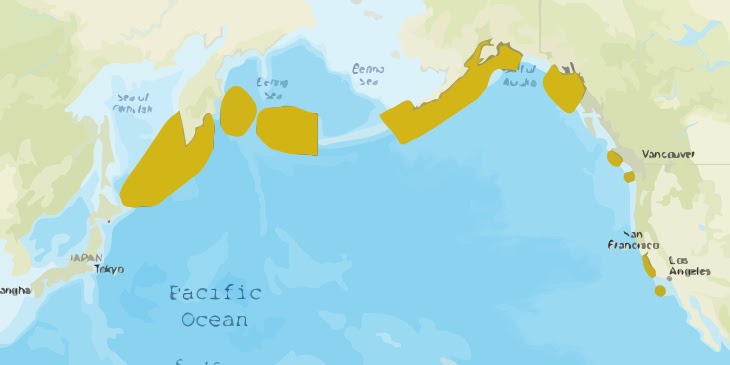
The Sea Otter range traditionally rimmed the outlying land/islands of the northern Pacific Ocean from Baja Mexico around Japan; currently they are restricted to the sporadic range shown in tan below.


Sea Otters at Seattle Aquarium, eating, playing, cleaning, and watching the tourists!


Live WILD Sea Otter mom giving birth near Monterey Bay Aquarium


PBS's NATURE on Sea Otters

Another PBS documentary, thsi time from Jean-Michel Cousteau!


If you want more in-depth reading a few research articles you could explore on these otters includes:

CK Johnson, MT Tinker, JA Estes… - Proceedings of the …, 2009 - National Acad Sciences
>   Southern sea otter as a sentinel of marine ecosystem health,DA Jessup, M Miller, J Ames, M Harris, C Kreuder… - EcoHealth, 2004 - Springer
>   Foraging patterns and prey selection in an increasing and expanding sea otter population,KL Laidre, RJ Jameson - Journal of Mammalogy, 2006 - BioOne
> Gene transcription in sea otters (Enhydra lutris); development of a diagnostic tool for sea otter and ecosystem health, L Bowen, AK Miles, M Murray… - Molecular ecology …, 2012

Wednesday, January 25, 2017

Asian Small-Clawed Otter - The Basics!

Asian Small-Clawed Otter
(Aonyx cinereus)


As promised, the posts this week are brief overviews of EACH of the otter species, focusing on recent information about each species and a vid or 2...
This is the 3rd of the 3 otter species that are found *only* in Asia, !


The Asian Small-Clawed Otter is the smallest of all otter species, and also, arguably, the most social. They mate for life, and live in family groups of between four and twelve, and sometimes up to twenty, otters. The group hunts, plays, and sleeps together. These otters will travel a long distance out of water in search of new habitats. They don't generally dive deeper than their body length in search of food, and spend more time out of the water than most otter species.

(Was also known as Oriental Small-Clawed Otter).

Status: Vulnerable and Decreasing 


The areas in yellow on the map below show where the Asian Small-Clawed Otter lives in southeast Asia. Despite how adaptable they are, they have become extinct in large parts of their original range.


Asian Small-Clawed Otters are very social and gregarious, watch and see for yourself!

 Asian Small-Clawed Otters (India) caught on camera by Wild Otters...


Here are a few clips of a family group kept at woodland Park Zoo (who participates in the Species Survival Plan):

...a group of otters is, appropriately, called a romp... 


...otters interacting with a crow (starts @ 3.20)... 


...nap time at Woodland Park Zoo 


If you want more in-depth reading a few research articles you could explore on these otters includes:

>   Conservation of the Asian small-clawed otter (Aonyx cinereus) in human-modified landscapes, Western Ghats, India, N Prakash, D Mudappa, TRS Raman… - Tropical Conservation …, 2012
>   Science-driven management of protected areas: a Philippine case study, NAD Mallari, NJ Collar, PJK McGowan… - Environmental …, 2013


.

Tuesday, January 24, 2017

Congo Clawless Otter - The Basics

Congo Clawless Otter 
(Aonyx congicus)

As promised, the posts this week are brief overviews of EACH of the otter species, focusing on recent information about each species and a vid or 2...
We hope you enjoy! :)  


The Congo Clawless Otters' back feet have small claws on the three middle toes, and very little webbing. The front feet have very small claws and no webbing. The front paws are very sensitive, like those of its close relative the Cape Clawless Otter, to increase it's success in finding food under rocks and in the mud.  Their short fur (providing less insulation) and the abbreviated webbing of its feet make the Congo Clawless Otter the otter least adapted for life in the water. Congo Clawless Otters are mostly solitary, only interacting with other otters when monogamous pairs come together to mate.


Status: Near Threatened and Decreasing.


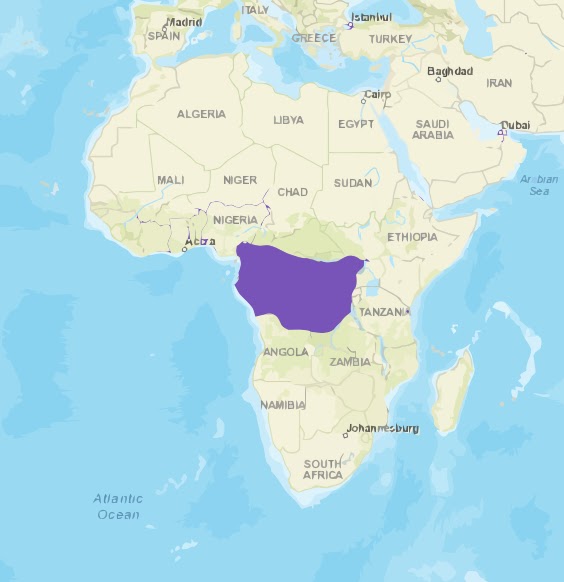
The Congo Clawless Otter is native to the Congo Region of southern Africa, as shown in purple on  the map to the left.


The Congo Clawless Otter's habitat is mostly surrounded by the habitat of Cape (african) Clawless Otter and overlaps with parts of the Spotted-necked Otter's habitat..


Video from research done on the Congo Clawless Otter (Davenport, et al... 2011)


Naia, an orphaned and partially paralyzed Congo Clawless Otter, rehabbing during her first BIG SWIM, 2013!


If you want more in-depth reading a few research articles you could explore on these otters includes:


>   Local hunting of carnivores in forested Africa: a meta-analysis, 2014

>   Divergent Skull Morphology Supports Two Trophic Specializations in Otters (Lutrinae)

>  Diet, foraging behaviour and coexistence of African otters and the water mongoose, DT Rowe-Rowe, MJ Somers, 1998