Showing posts with label Africa. Show all posts

Wednesday, January 25, 2017

Eurasian Otter - The Basics!

Eurasian Otter
(Lutra lutra)

As promised, the posts this week are brief overviews of EACH of the otter species, focusing on recent information about each species and a vid or 2...
There is a LOT of information "out there" about the Eurasian Otter,
they are the considered the "typical" otter
(just take a look at that genus and species name! ; ) ;
consider this just a brief intro, a sneak peek, at the only otter species 
that can be found on THREE continents!


Eurasian Otters are found across most of Europe and Asia AND in parts of northern Africa. They are always found near water, fresh or salt, as long as there are freshwater pools nearby for drinking and bathing. They tend to live alone except when mating, when the male and female may stay close together for ~ a week, or for females when raising a litter. Though they are excellent swimmers, Eurasian Otters can only hold their breath for about 30 seconds!


Status: Near Threatened and Decreasing


The teal area in the map below shows where the Eurasian Otter is known to exist; it may be found in other small sub-populations not shown.


For our Eurasian Otter videos, we have a treat, one of Questˣ's friends, Andy Coventry, takes some of the most wonderful videos (and photos) of Eurasian otters! 

Here is a link to a video he shared with us recently of 2 Eurasian otters swimming in the River Don, Scotland.

Video about the Eurasian Otter Conservation Program, on otter conservation in Israel


 ...and here's some video from Pembrokeshire,Wales, taken by Dawn and Jim...


...and a white-tailed eagle after an otter's meal off the Island of Mull, watch closely!


If you want more in-depth reading a few research articles you could explore on these otters includes:

>   An evaluation of field and noninvasive genetic methods for estimating Eurasian otter population size, P Hájková, B Zemanová, K Roche, B Hájek - Conservation Genetics, 2009
>   Competition between Eurasian otter Lutra lutra and American mink Mustela vison probed by niche shift., L Bonesi, P Chanin, DW Macdonald - Oikos, 2004

>   Chemical contaminants in fish species from rivers in the North of Luxembourg: Potential impact on the Eurasian otter (Lutra lutra), A Boscher, S Gobert, C Guignard, J Ziebel, L L'Hoste… - Chemosphere, 2010
>   The reintroduction of the Eurasian otter (Lutra lutra) into the Netherlands: hidden life revealed by noninvasive genetic monitoring,HP Koelewijn, M Pérez-Haro, HAH Jansman… - Conservation …, 2010
L Remonti, A Balestrieri… - Canadian Journal of …, 2009


Tuesday, January 24, 2017

Spotted-Necked Otters - The Basics

  Spotted-Necked Otter 
(Hydrictis maculicollis)

As promised, the posts this week are brief overviews of EACH of the otter species, focusing on recent information about each species and a vid or 2...
This is the last of the 3 species of fully African otters, enjoy! :)  


Due to genetics work done on otters, this otter has been put in to a new genus, Hydrictis! (more about that in another post!)
Spotted-necked Otters are fairly small, weighing 10 to 20 lbs.They live alone or in small family groups, but often form social and hunting groups of five to twenty members. They spend more time in the water than other freshwater species, almost never leaving the water or water's edge. Resting sites, holts, latrines, and breeding areas are all right next to the water; they're not very agile on land, but, like other otters, the Spotted-necked Otter tends to turn everything it does into a game!

Status: Near Threatened and Decreasing


 The Spotted-Necked Otter is native to large parts of southern Africa, as shown in green in the map to the left.


The Spotted-Necked Otter's habitat in places overlaps the habitat of the Cape (african) Clawless Otter and the Congo Clawless Otter (shown in the 2 previous blogs!).


 Videos of Spotted-necked otters in the wild are few and far between, so... until I can track some good ones down here is video from the San Diego Zoo!


If you want more in-depth reading a few research articles you could explore on these otters includes:


>   Differentiation of two South African otter species (Aonyx capensis and Lutra maculicollis) from spraint based on partial CytB primer sets,MT Madisha, et al, 2015
>  Conflict between spotted-necked otters and fishermen in Hlan River, Benin,AH Akpona et al, 2015
>  Capacity building to conserve African otters,H Akpona et al, 2016


Congo Clawless Otter - The Basics

Congo Clawless Otter 
(Aonyx congicus)

As promised, the posts this week are brief overviews of EACH of the otter species, focusing on recent information about each species and a vid or 2...
We hope you enjoy! :)  


The Congo Clawless Otters' back feet have small claws on the three middle toes, and very little webbing. The front feet have very small claws and no webbing. The front paws are very sensitive, like those of its close relative the Cape Clawless Otter, to increase it's success in finding food under rocks and in the mud.  Their short fur (providing less insulation) and the abbreviated webbing of its feet make the Congo Clawless Otter the otter least adapted for life in the water. Congo Clawless Otters are mostly solitary, only interacting with other otters when monogamous pairs come together to mate.


Status: Near Threatened and Decreasing.


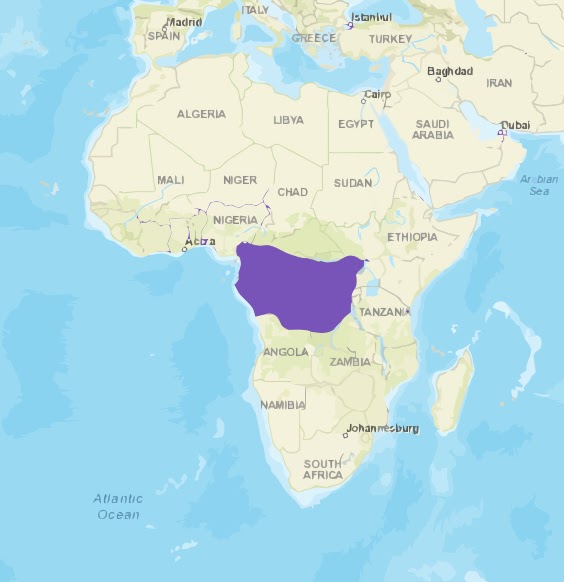
The Congo Clawless Otter is native to the Congo Region of southern Africa, as shown in purple on  the map to the left.


The Congo Clawless Otter's habitat is mostly surrounded by the habitat of Cape (african) Clawless Otter and overlaps with parts of the Spotted-necked Otter's habitat..


Video from research done on the Congo Clawless Otter (Davenport, et al... 2011)


Naia, an orphaned and partially paralyzed Congo Clawless Otter, rehabbing during her first BIG SWIM, 2013!


If you want more in-depth reading a few research articles you could explore on these otters includes:


>   Local hunting of carnivores in forested Africa: a meta-analysis, 2014

>   Divergent Skull Morphology Supports Two Trophic Specializations in Otters (Lutrinae)

>  Diet, foraging behaviour and coexistence of African otters and the water mongoose, DT Rowe-Rowe, MJ Somers, 1998

Cape/ African Clawless Otter - The Basics

 Cape / African Clawless Otter
(Aonyx capensis)

As promised, the posts this week are brief overviews of EACH of the otter species, focusing on recent information about each species and a vid or 2...

We hope you enjoy! :)  


The Cape Clawless Otter's feet have almost no webbing, and claws only on the three middle toes of the hind feet. The front feet are very sensitive and hand-like; they are so dexterous with their front paws that they are left- or right-handed, just like people are. They use their hands to dig for prey in the mud or under rocks. They tend to form loose social and foraging groups with other otters.  Like other otters, they are incredibly playful and are excellent swimmers.


Status: Near Threatened and Decreasing.


The Cape (or African) Clawless Otter is native to large parts of southern Africa, as shown in red on  the map to the left.


Where the Cape (African) Clawless are absent in the Congo region, they are replaced in that habitat by the Congo Clawless Otter.


In this video, Ottie , an African Clawless otter rehabbing at the Back to the Wild Program, chases a butterfly in his free time! (thank you Audrey Delsink)


...and here is a group together near Table Mountain National Park, South Africa. (thank you TMNP!)


If you want more in-depth reading a few research articles you could explore on these otters includes:

>  Angelici, F.M., Politano, E., Bogudue, A.J. and Luiselli, L. 2005. Distribution and habitat of otters (Aonyx capensis and Lutra maculicollis) in southern Nigeria. Italian Journal of Zoology 72(3): 223-227.
>  Dixon, R.K., Smith, J. and Guill, S. 2003. Life on the Edge: Vulnerability and Adaptation of African Ecosystems to Global Climate Change. Mitigation and Adaptation Strategies for Global Change 8: 93-113.
>  Differentiation of two South African otter species from spraint based on partial CytB primer cells

Tuesday, March 8, 2016

A Brief List of Women Scientists through Time (Antiquity a.k.a. pre-5th century CE)

I start this blog with a caveat, throughout history there has been a tendency to under-report on women participating in the sciences... what follows is definitely not a comprehensive list. Please add your finds to the following list:

  •  Merit Ptah, (2700 BCE) the world's first, currently known, female physician. 
  • Enheduanna (c. 2285–2250 BCE), Sumerian (Akkadian) astronomer and poet, daughter of King Sargon of Akkad.
  • Tapputi-Belatekallim  (~1200 BCE mentioned in a clay tablet dated), considered the first chemist. She was a Babylonian perfumer, the first person in history recorded as using a chemical process, the first referenced still.
  • Theano (6th century BCE), philosopher, mathematician and physician
  •  Perictione (5th century BCE), Greek philosopher, mother of Plato
  •  Arete of Cyrene (5th–4th centuries BCE), natural and moral philosopher, North Africa
  •  Pythias of Assos (4th century BCE), Greek biologist and embryologist with a special interest in marine zoology.
  •  Agnodice (4th century BCE), potentially the first woman physician to practice legally in Athens. The story goes that she hid her gender except to her female patients, so she would be able to practice medicine, especially gynecology. When many women quit going to the the male doctors they brought Agnodice before the court and accused Agnodice of seducing "his" female patients. Agnodice then, graphically, exposed that she was a female. The response was to then  condemn her for violating the law by studying medicine. A crowd of women arrived to praise her medical successes. The result, the laws of Athens were changed and women physicians were allowed to treat women.
  • Hypatia (370–415), Greek mathematician, astronomer, and philosopher.
  • Aemilia (300-363 BCE), Gallo-Roman physician
  • Favilla (2nd century), Roman physician.
  • Aglaonice (1st or 2nd c. BCE), astronomer Greece, regarded as a sorceress for her ability to make the moon disappear, in other words she could predict the time and ~area where a lunar eclipse would occur. One of a group considered the "witches of Thessaly", that were active from the 3rd to 1st centuries BCE.
  •  Maria Prophetissa (b/n 1st and 3rd c. CE), considered first western alchemist, developed several pieces of chemical apparatus.
  •  Metrodora (ca. 200-400 AD), Greek physician and author
  • Leoparda (4th century AD), physician and gynecologist
  • Macrina (4th century AD), Greek physician and nun