Showing posts with label threatened. Show all posts

Thursday, January 26, 2017

Neotropical Otter - Basics

Neotropical Otter
(Lontra longicaudis)


As promised, the posts this week are brief overviews of EACH of the otter species, focusing on recent information about each species and a vid or 2...
Neotropical Otters latin name (Lontra longicaudis) means Otter with looong tail! 
I hope that you enjoy exploring them!


Unlike most otter species, Neotropical Otters are relatively solitary and are very elusive even in pristine habitats. Male and female Neotropical Otters meet one day a year for breeding, and then go their separate ways. Neotropical Otters prefer clear, fast-flowing water. Habitat destruction and water pollution are major threats to this species.


Status: Near Threatened and Decreasing
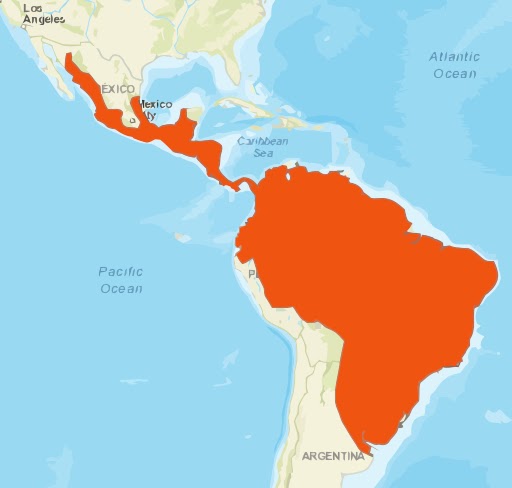


Neotropical Otters are found through most of Mexico all the way south to Argentina (except in arid regions). It's habitat range approaches the North American River Otter to the north and the South American River Otter to the south.


This species occurs in it's range from sea level to 4,000 meters (over 13,000 feet altitude).


This species is very shy and elusive,s o getting good videos isn't easy!

A couple of Neotropical Otters together (wild)


Neotropical Otter videos, swimming and grooming (in captivity)


If you want more in-depth reading a few research articles you could explore on these otters includes:

>   Trophic ecology and the use of shelters and latrines by the Neotropical otter (Lontra longicaudis) in the Taquari Valley, Southern Brazil, CB Kasper, VAG Bastazini, J Salvi. Iheringia. Série, 2008
O Carvalho-Junior, AB Birolo. IUCN Otter Spec., 2010
>   Seasonal and spatial differences in feeding habits of the Neotropical otter Lontra longicaudis (Carnivora: Mustelidae) in a coastal catchment of southeastern. ML Rheingantz, HF Waldemarin, L Rodrigues.  Zoologia , 2011
>   Defining Neotropical otter Lontra longicaudis distribution, conservation priorities and ecological frontiers, ML Rheingantz, JFS de Menezes. Tropical Conservation, 2014

Tuesday, January 24, 2017

Spotted-Necked Otters - The Basics

  Spotted-Necked Otter 
(Hydrictis maculicollis)

As promised, the posts this week are brief overviews of EACH of the otter species, focusing on recent information about each species and a vid or 2...
This is the last of the 3 species of fully African otters, enjoy! :)  


Due to genetics work done on otters, this otter has been put in to a new genus, Hydrictis! (more about that in another post!)
Spotted-necked Otters are fairly small, weighing 10 to 20 lbs.They live alone or in small family groups, but often form social and hunting groups of five to twenty members. They spend more time in the water than other freshwater species, almost never leaving the water or water's edge. Resting sites, holts, latrines, and breeding areas are all right next to the water; they're not very agile on land, but, like other otters, the Spotted-necked Otter tends to turn everything it does into a game!

Status: Near Threatened and Decreasing


 The Spotted-Necked Otter is native to large parts of southern Africa, as shown in green in the map to the left.


The Spotted-Necked Otter's habitat in places overlaps the habitat of the Cape (african) Clawless Otter and the Congo Clawless Otter (shown in the 2 previous blogs!).


 Videos of Spotted-necked otters in the wild are few and far between, so... until I can track some good ones down here is video from the San Diego Zoo!


If you want more in-depth reading a few research articles you could explore on these otters includes:


>   Differentiation of two South African otter species (Aonyx capensis and Lutra maculicollis) from spraint based on partial CytB primer sets,MT Madisha, et al, 2015
>  Conflict between spotted-necked otters and fishermen in Hlan River, Benin,AH Akpona et al, 2015
>  Capacity building to conserve African otters,H Akpona et al, 2016


Congo Clawless Otter - The Basics

Congo Clawless Otter 
(Aonyx congicus)

As promised, the posts this week are brief overviews of EACH of the otter species, focusing on recent information about each species and a vid or 2...
We hope you enjoy! :)  


The Congo Clawless Otters' back feet have small claws on the three middle toes, and very little webbing. The front feet have very small claws and no webbing. The front paws are very sensitive, like those of its close relative the Cape Clawless Otter, to increase it's success in finding food under rocks and in the mud.  Their short fur (providing less insulation) and the abbreviated webbing of its feet make the Congo Clawless Otter the otter least adapted for life in the water. Congo Clawless Otters are mostly solitary, only interacting with other otters when monogamous pairs come together to mate.


Status: Near Threatened and Decreasing.


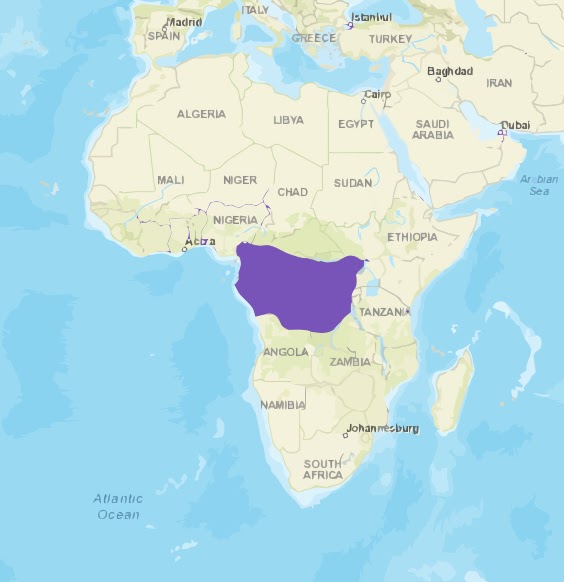
The Congo Clawless Otter is native to the Congo Region of southern Africa, as shown in purple on  the map to the left.


The Congo Clawless Otter's habitat is mostly surrounded by the habitat of Cape (african) Clawless Otter and overlaps with parts of the Spotted-necked Otter's habitat..


Video from research done on the Congo Clawless Otter (Davenport, et al... 2011)


Naia, an orphaned and partially paralyzed Congo Clawless Otter, rehabbing during her first BIG SWIM, 2013!


If you want more in-depth reading a few research articles you could explore on these otters includes:


>   Local hunting of carnivores in forested Africa: a meta-analysis, 2014

>   Divergent Skull Morphology Supports Two Trophic Specializations in Otters (Lutrinae)

>  Diet, foraging behaviour and coexistence of African otters and the water mongoose, DT Rowe-Rowe, MJ Somers, 1998