Wednesday, January 25, 2017

Hairy Nosed Otters - The Basics

Hairy-Nosed Otter
(Lutra sumatrana)

As promised, the posts this week are brief overviews of EACH of the otter species, focusing on recent information about each species and a vid or 2...
This is the first of the 3 otter species that are found *only* in Asia, enjoy exploring them!


Very little is known about the Hairy-Nosed Otter. It is endangered and rare. The nose is completely covered in hair, and the feet are webbed, with strong claws.The major threat to Hairy-nosed Otters is from humans: hunting, habitat competition, destruction, and pollution. Despite efforts to establish a captive breeding program, there have only been three of these otters held in captivity (all male).


Status: Endangered and Decreasing


 The Hairy-nosed otter is found in small areas scattered across the area shown in purple in the map to the left.


This otter is extremely reclusive and rare, so are the videos:

Link to Hairy-nosed otter video and conservation in Cambodia.

Brief vid of a young hairy-nosed otter entering the water!


If you want more in-depth reading a few research articles you could explore on these otters includes:


>   Food Habitats of the Hairy-nosed otter (Lutra sumatrana) and the Small clawed otter (Amblonyx cinerea) in Pru Toa Daeng Peat Swamp Rorest, Southern Thailand. Kanchanasakha, B.K. 2007. 

>   Keep wetlands wet: the myth of sustainable development of tropical peatlands–implications for policies and management ,S Evers, CM Yule, R Padfield, P O'reilly… - Global change …, 2016
>   Camera trapping for the study and conservation of tropical carnivores.R Sollmann, A Mohamed, MJ Kelly - The Raffles Bulletin of Zoology, 2013 -

Tuesday, January 24, 2017

Spotted-Necked Otters - The Basics

  Spotted-Necked Otter 
(Hydrictis maculicollis)

As promised, the posts this week are brief overviews of EACH of the otter species, focusing on recent information about each species and a vid or 2...
This is the last of the 3 species of fully African otters, enjoy! :)  


Due to genetics work done on otters, this otter has been put in to a new genus, Hydrictis! (more about that in another post!)
Spotted-necked Otters are fairly small, weighing 10 to 20 lbs.They live alone or in small family groups, but often form social and hunting groups of five to twenty members. They spend more time in the water than other freshwater species, almost never leaving the water or water's edge. Resting sites, holts, latrines, and breeding areas are all right next to the water; they're not very agile on land, but, like other otters, the Spotted-necked Otter tends to turn everything it does into a game!

Status: Near Threatened and Decreasing


 The Spotted-Necked Otter is native to large parts of southern Africa, as shown in green in the map to the left.


The Spotted-Necked Otter's habitat in places overlaps the habitat of the Cape (african) Clawless Otter and the Congo Clawless Otter (shown in the 2 previous blogs!).


 Videos of Spotted-necked otters in the wild are few and far between, so... until I can track some good ones down here is video from the San Diego Zoo!


If you want more in-depth reading a few research articles you could explore on these otters includes:


>   Differentiation of two South African otter species (Aonyx capensis and Lutra maculicollis) from spraint based on partial CytB primer sets,MT Madisha, et al, 2015
Conflict between spotted-necked otters and fishermen in Hlan River, Benin,AH Akpona et al, 2015
Capacity building to conserve African otters,H Akpona et al, 2016


Congo Clawless Otter - The Basics

Congo Clawless Otter 
(Aonyx congicus)

As promised, the posts this week are brief overviews of EACH of the otter species, focusing on recent information about each species and a vid or 2...
We hope you enjoy! :)  


The Congo Clawless Otters' back feet have small claws on the three middle toes, and very little webbing. The front feet have very small claws and no webbing. The front paws are very sensitive, like those of its close relative the Cape Clawless Otter, to increase it's success in finding food under rocks and in the mud.  Their short fur (providing less insulation) and the abbreviated webbing of its feet make the Congo Clawless Otter the otter least adapted for life in the water. Congo Clawless Otters are mostly solitary, only interacting with other otters when monogamous pairs come together to mate.


Status: Near Threatened and Decreasing.


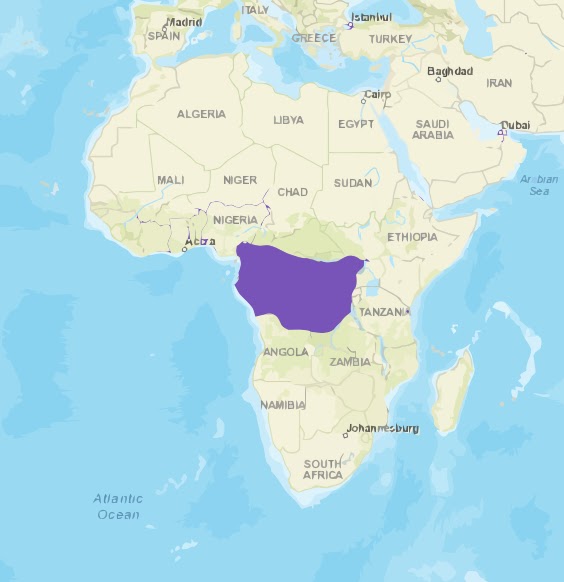
The Congo Clawless Otter is native to the Congo Region of southern Africa, as shown in purple on  the map to the left.


The Congo Clawless Otter's habitat is mostly surrounded by the habitat of Cape (african) Clawless Otter and overlaps with parts of the Spotted-necked Otter's habitat..


Video from research done on the Congo Clawless Otter (Davenport, et al... 2011)


Naia, an orphaned and partially paralyzed Congo Clawless Otter, rehabbing during her first BIG SWIM, 2013!


If you want more in-depth reading a few research articles you could explore on these otters includes:


>   Local hunting of carnivores in forested Africa: a meta-analysis, 2014

>   Divergent Skull Morphology Supports Two Trophic Specializations in Otters (Lutrinae)

Diet, foraging behaviour and coexistence of African otters and the water mongoose, DT Rowe-Rowe, MJ Somers, 1998

Cape/ African Clawless Otter - The Basics

 Cape / African Clawless Otter
(Aonyx capensis)

As promised, the posts this week are brief overviews of EACH of the otter species, focusing on recent information about each species and a vid or 2...

We hope you enjoy! :)  


The Cape Clawless Otter's feet have almost no webbing, and claws only on the three middle toes of the hind feet. The front feet are very sensitive and hand-like; they are so dexterous with their front paws that they are left- or right-handed, just like people are. They use their hands to dig for prey in the mud or under rocks. They tend to form loose social and foraging groups with other otters.  Like other otters, they are incredibly playful and are excellent swimmers.


Status: Near Threatened and Decreasing.


The Cape (or African) Clawless Otter is native to large parts of southern Africa, as shown in red on  the map to the left.


Where the Cape (African) Clawless are absent in the Congo region, they are replaced in that habitat by the Congo Clawless Otter.


In this video, Ottie , an African Clawless otter rehabbing at the Back to the Wild Program, chases a butterfly in his free time! (thank you Audrey Delsink)


...and here is a group together near Table Mountain National Park, South Africa. (thank you TMNP!)


If you want more in-depth reading a few research articles you could explore on these otters includes:

>  Angelici, F.M., Politano, E., Bogudue, A.J. and Luiselli, L. 2005. Distribution and habitat of otters (Aonyx capensis and Lutra maculicollis) in southern Nigeria. Italian Journal of Zoology 72(3): 223-227.
>  Dixon, R.K., Smith, J. and Guill, S. 2003. Life on the Edge: Vulnerability and Adaptation of African Ecosystems to Global Climate Change. Mitigation and Adaptation Strategies for Global Change 8: 93-113.
>  Differentiation of two South African otter species from spraint based on partial CytB primer cells

Monday, January 23, 2017

ALL Otters Week! (we have our reasons... but you benefit! ;)

This week we'll be looking at... wait for it... OTTERS!
Which otters?!?

ALL OTTERS!

We'll take a brief peek each day at what is currently going on with each of the otter species around the world, right now...


First, some basic info about each species. There are 13 known modern species of otters, spread out across 5 of the 7 continents of the world.  Otters are not found in Australia, the surrounding islands, or Antarctica. See map above for distribution of specific species.


 Currently all, but one, of the species are experiencing a decline in populations. Five otter species are considered endangered, 2 are considered vulnerable (or near threatened), 5 are listed as near threatened, and only one of the species listed is in the category of "least concern" by the IUCN Otter Specialist Group.


Otter species status:                                                                  Status                         Population Trend  

Sea Otter ~ Enhydra lutris Endangered Decreasing
North American River Otter ~ Lontra canadensis Least Concern Stable
Neotropical Otter ~ Lontra longicaudis Near Threatened Decreasing
Marine Otter ~ Lontra felina Endangered Decreasing
South American River Otter ~ Lontra provocax Endangered Decreasing
Giant Otter ~ Pteronura brasiliensis Endangered Decreasing
Spotted-Necked Otter ~ Hydrictis maculicollis Near Threatened Decreasing
African/Cape Clawless Otter ~ Aonyx capensis Near Threatened Decreasing
Congo Clawless Otter ~ Aonyx congicus Near Threatened Decreasing
Eurasian Otter ~ Lutra lutra Near Threatened Decreasing
Hairy Nosed Otter ~ Lutra sumatrana Endangered Decreasing
Smooth Coated Otter ~ Lutrogale perspicillata Vulnerable Decreasing
Asian Small-Clawed Otter ~ Aonyx cinereus Vulnerable Decreasing


An introduction to each otter species...

Sea Otter ~ Enhydra lutris

Sea Otters spend their entire lives in the ocean, only leaving the water in the case of extremely bad storms. They are also one of the known tool-using mammals, using rocks to break shells open so they can consume the shellfish inside. It is important that they are able to do this well because they have to eat about 30% of their body weight every day!


North American River Otter ~ Lontra canadensis

North American River Otters are highly adaptable to different types of habitats, but are very sensitive to pollution and changes in water quality. They are extremely playful, and turn almost all regular activities into a game. They do not tend to pair-bond (though sometimes they do), but males will help to raise the pups if given the opportunity. Males tend to be more solitary than females, but they don't do well alone for long periods of time and will seek out the company of other otters.


Neotropical Otter ~ Lontra longicaudis

Unlike most otter species, Neotropical Otters are relatively solitary. Male and female Neotropical Otters meet one day a year for breeding, and then go their separate ways. Neotropical Otters prefer clear, fast-flowing water. Habitat destruction and water pollution are major threats to this species.


Marine Otter ~ Lontra felina

Marine Otters seem to be the only otter other than the sea otter that do not require access to fresh water to wash themselves. Though Marine Otters tend to be solitary, they are generally friendly (but not highly sociable) with other otters. They do sometimes hunt cooperatively, groups of two or three otters working together to catch larger fish. Also, Marine Otters have hairy noses! (Also known as the Sea Cat)

 
Southern River Otter ~ Lontra provocax

Southern River Otters tend to have a very short life span. Few live to maturity, and only 1% live to 10 years of age. They are generally solitary, coming together mainly to mate. The female raises the pups alone, and there are no social groups beyond this.   They have territories like other otters, but the size of these territories is unknown and it appears that they are not particularly defensive of them.

 
Giant Otter ~ Pteronura brasiliensis

From nose to tail, Giant Otters can be up to 6ft long! Their tails are flattened and flanged, and very strong. Their ears are comparably small, and their eyes very large.  Giant Otters are at the top of the Brazilian food chain. They eat fish, small caiman, crustaceans, snakes, and birds. Giant Otters are incredibly sociable, and often hunt in groups. They live in family groups of ten or more, sometimes up to twenty otters!


Spotted-Necked Otter ~ Hydrictis maculicollis

Due to genetics work done on otters, this otter has been put in to a new genus, Hydrictis! (more about that in an other post!)
Spotted-necked Otters are fairly small, weighing form 10 to 20 lbs.They live alone or in small family groups, but often form social and hunting groups of five to twenty members. They spend more time in the water than other freshwater species, almost never leaving the water's edge. Resting sites, holts, latrines, and breeding areas are all right next to the water; they are not very agile on land. Like other otters, the Spotted-necked Otter tends to turn everything it does into a game.


Cape/African Clawless Otter ~ Aonyx capensis

The Cape Clawless Otter's feet have almost no webbing, and claws only on the three middle toes of the hind feet. The front feet are very sensitive and hand-like. In fact, they are so dexterous with their front paws that they are left- or right-handed, just like people are. They use their hands to dig for prey in the mud or under rocks. They tend to form loose social and foraging groups with other otters.  Like other otters, they are incredibly playful and are excellent swimmers.They don't spend as much time in the water as other otters, and are willing to travel farther from it in search of a new home. (Also known as African Clawless Otter)


Congo Clawless Otter ~ Aonyx congicus

Congo Clawless Otters' back feet have small claws on the three middle toes, and very little webbing. The front feet have very small claws and no webbing. The front paws are very sensitive, like those of its close relative the Cape Clawless Otter, to increase success in finding food under rocks and in the mud.  Their short fur (providing less insulation) and the abbreviated webbing of its feet make the Congo Clawless Otter the least adapted otter for life in the water. Congo Clawless Otters are mostly solitary, only interacting with other otters when monogamous pairs come together to mate.


Eurasian Otter ~ Lutra lutra

Eurasian Otters are found almost everywhere in Europe and Asia that is near water, fresh or salt, as long as there are freshwater pools nearby for drinking and bathing. They tend to live alone except when mating, when the male and female may stay close together for about a week, or for females, when raising a litter. Though they are excellent swimmers, Eurasian Otters can only hold their breath for about 30 seconds!


Hairy Nosed Otter ~ Lutra sumatrana

Very little is known about the Hairy Nosed Otter. It is endangered and incredibly rare. The nose is completely covered in hair, and the feet are webbed, with strong claws.The major threat to Hairy Nosed Otters is from humans: hunting, habitat competition, destruction, and pollution. Despite efforts to establish a captive breeding program, there have only been three of these otters held in captivity (and unfortunately, all male).


Smooth Coated Otter ~ Lutrogale perspicillata 

The Smooth Coated Otter prefers to live in undisturbed areas. They hunt during the day and at night, sometimes alone and sometimes in large groups. Smooth Coated Otters mate for life, and live in family groups consisting of the mated pair and their pups (often including full-grown pups). The alpha female is dominant and determines hierarchy within the group, while the alpha male moves the group through their territory. Smooth Coated Otters are proficient both on land and in water. They are powerful swimmers, and on land they climb and jump quite well.

 
Asian Small-Clawed Otter ~ Aonyx cinereus

 The Asian Small-Clawed Otter is the smallest of all otter species, and also the most social. They mate for life, and live in family groups of between four and twelve, and sometimes up to twenty, otters. The group hunts, plays, and sleeps together. These otters will travel a long distance out of water in search of new habitats. They don't generally dive deeper than their body length in search of food, and spend more time out of the water than most otter species.
(Also known as Oriental Small-Clawed Otter)


http://otterquest.blogspot.com/2017/01/all-otters-week-whether-you-like-it-or.html

Friday, January 20, 2017

ColorMe Penguin Aware!


Right click and save to your desk top to print/color this page!


It's Penguin Awareness Day!

Do YOU know where YOUR penguin is?!?

Maybe *your penguin* is at your favorite zoo/ aquarium... maybe *your penguin* is a wild Emperor Penguin in Antarctica... maybe *your penguin* is the only penguin in the wild that *does* occasionally cross in to the northern hemisphere...? (yep, one *can* do that, do you know which one? without googling?!? ;) ...if not, I promise to tell you later in this post!)

If you were a victim viewer of "March of the Penguins" you know how much the time of the year can impact daily life for a penguin, happily (for me, at least, who worries about these critters), Penguin Awareness Day falls one month after the longest day of the year in the southern hemisphere (where all penguins natively live), when those most southerly penguins, the Emperor Penguins, are starting their summer foraging!

So... it's a good time, for me ;) , to talk penguins...

This year, to celebrate Penguin Awareness Day, I'm going to share a few facts about penguins (including why penguin awareness is actually relevant to all of us) and a couple videos taken of one of *my* penguins, the Humboldt Penguins at Woodland Park Zoo, Seattle.

Meet the Humboldt Penguin!

This one seems to be on her/his lunchtime exercise routine!

...and I'm trying to find out what all of the hooting is about... I'll let you know when I do!

 In honor of Penguin Awareness Day Quest plans to post more penguin vids!


Humboldt Penguins (Spheniscus humboldti) are an endangered species, native to the Central Pacific coast of South America (Peru and Chile). Natively they live on rocky coastlines and tend to be about 15"-18"(37-45cm) tall and weigh about 9 lbs (4kg).
Woodland Park Zoo participates in the Species Survival Plan for the Humboldt Penguins and supports the Humboldt Penguin Preservation Project in Peru. Because of the extra protection and high quality of food, these penguins, which live about 20 years in the wild, *can* live up to 30 years in *healthy* zoo environments. They reach maturity from 2 to 7 years of age and are monogamous (choose one mate for life).
The female lays one or two eggs and both parents participate in incubating (keeping the egg/s warm) for the 40 days until hatching and both parents participate in raising the chick/s.


Penguin Awareness Day also helps to make us more aware of how even subtle changes to our earth's environment can massively impact life on earth: shorelines, icy habitats, and food resources. (more on this hopefully soon, i have to take this call!)


I didn't forget!
The answer to which wild penguin lives the farthest north - the Galapagos Penguin!

Cold ocean currents, called the Humboldt Current and the Cromwell Current, keep the waters around the Galapagos Islands cool and nutrient rich, which allows the Galapagos Penguin to be the most northerly penguin species, even sometimes found across the equator, in the northern hemisphere! (barely! ;) )