Showing posts with label atmosphere. Show all posts

Thursday, March 23, 2017

Understanding Clouds on World Meteorological Day, 2017


This year's theme for World Meteorological day is *Understanding Clouds*.


https://public.wmo.int/en/WorldMetDay2017

Clouds are created made of small drops of water, clustered together.

For *beginners* there are the 3 basic types of clouds:


Cumulus - thick, puffy clouds that tend to be white on top and on the edges with a darker, flat bottom. They kinda look like cotton-balls or cauliflower (depending on your preference ;)  ).


Cirrus - wispy, transparent / white, icy clouds. They are sheer clouds actually composed of ice crystals!


Stratus - low hanging clouds in dark/gray layer. These clouds can produce drizzle, ice prisms, and snow.


Understanding these clouds helps to understand weather, and to forecast the weather you can expect!

Here's a more advanced cloud chart from NOAA (and a link to a NOAA .pdf of clouds): 
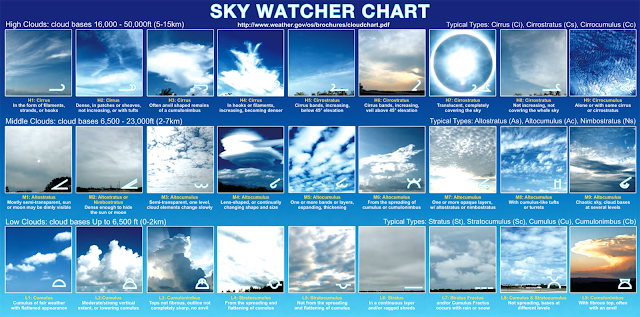
http://www.nws.noaa.gov/om/brochures/cloudchart.pdf
click to view this chart larger!


...for more information about World Meteorological Day

Saturday, April 16, 2016

Water Cycle #3 (complete!) > National Water Week (April 10- 16)

Basics of


ACTIVE PARTS
Evaporation
Transpiration /
Evapotranspiration
RunOff
Condensation
Sublimation
Seepage
Precipitation (rain, snow, fog, etc.)
Infiltration
Plant UpTake
Recharge
Flow
PHYSICAL PARTS
Sun (solar energy)
Clouds
Lake
River
Cloud
Plants/ Trees
Spring
Ground Water
Atmosphere
Water Table


It's been a busy week, so, unfortunately that's all for National Water Week... but next week is Earth Day! (and the earth *is* ~70% water, so......   ; )   ).

.

Thursday, April 14, 2016

Water Cycle #2 (hints!) > National Water Week! (April 10- 16)

 As promised, here are a few hints to give you a starting place for filling in the water cycle coloring page.

 Try to look up some of the terms and put them in the diagram! On the last day of National Water Week, Saturday, I will add the definitions in case you can't find them.

Some of the terms used in describing the water cycle:


ACTIVE PARTS
Evaporation
Transpiration
Evapotranspiration
RunOff
Condensation
Sublimation
Seepage
Precipitation
Infiltration
Plant UpTake
Recharge
Flow
PHYSICAL PARTS
Sun
Clouds
Lake
River
Cloud
Plants/ Trees
Spring
GroundWater
Atmosphere


The blank coloring page:


And a colored page:


And last, for today, fill in the blanks!


I haven't given you all of the blanks, first try to fill in some on your own!

.